Polperro Authors
Authors have been as beguiled by Polperro as artists, and I have drawn on a number of the Polperro references contained in their output.

Polperro’s principal celebrity, certainly in the nineteenth century, is Dr Jonathan Couch (1789-1870), Doctor, Apothecary, Naturalist, with a special interest in ichthyology and ornithology, classical scholar, antiquarian, Methodist preacher, artist and local historian. His History of Polperro, written principally in the 1850s, but edited, added to and published in 1871 after his death by his son, Thomas Quiller-Couch, is, naturally, a primary source, but I have also devoted a chapter to the artwork that he produced for his celebrated four volume tome on British Fishes and for his other natural history books.
There is no doubt that Louisa Parr’s three volume novel, Adam and Eve, first published in book form in 1880, had a dramatic impact on the number of visitors coming to Polperro. It was based around the tale of the Lottery – a Polperro smuggling vessel that had had an engagement with a Revenue boat in 1898 during which a customs official had been killed. This had led to the Revenue authorities constantly raiding Polperro until all the crew were seized and the culprit identified – and eventually hanged. However, in the novel, the author waxed lyrical about the local scenery and the ambience of the village. Its publicity in 1885 recorded “All visitors to Cornwall know Polperro” – a statement that would have seemed laughable in 1879.

Thomas Quiller-Couch’s son, Arthur, writing under the pseudonym ‘Q’, also drew on his memories of the Polperro home of his grandfather, Jonathan Couch, in a number of his novels. Accordingly, the basis for the story for his first novel, Dead Man’s Rock, came from the tale of the ‘Tragic Key’. This was a key of a quadrant that Jonathan Couch’s father-in-law, Richard Quiller, had hung on a beam in ‘Couch’s House’, with strong instructions that no-one should take it off the nail until his return. As, on that voyage, his ship was lost at sea in a gale off Tenerife, he never did return, and the key became a venerated relic.9 Then, in another novel, from 1915, Nicky Nan, Reservist, the principal character lived in ‘Couch’s House’, and found there the hideaway in the Wig Cupboard, which had been used in times past to store smuggled goods or to escape detection by Press Gangs. This novel paints an interesting picture of Polperro at the time of the outbreak of WW1, with Nicky-Nan telling the local Bank Manager, “Six young men, as I know, waitin’ to marry and unable, because visitors snap up cottage after cottage for summer residences, an’ll pay you fancy prices; whereas you won’t build for the likes o’ we.” Sound familiar?
Between 1912 and 1921, the novelist, Hugh Walpole, rented a small cottage, ‘The Cobbles’ on The Warren, and incorporated descriptions of Polperro into some of his short stories. He also kept an interesting diary during the War years, whilst I found an article in a Californian newspaper, The Oakland Tribune, containing a fascinating description of his affinity for Polperro as told by his fellow indiscreet friend, Marie Belloc Lowndes. On the outbreak of WW1, Walpole was asked by the artist, Philip Streatfeild, to chaperone the young Noel Coward back to London. Coward features as one of the young male nudes in a painting by Streatfeild of boys swimming in the natural bathing pool by Peak Rock. After the War, visitors to Walpole’s cottage included Vita Sackville-West and Violet Keppel in the midst of their passionate affair and the young American-Danish opera singer, Lauritz Melchior, who caused a sensation when singing at a local concert in 1921.

After the War, Angela Brazil, famous for being the first British writer of “modern schoolgirl stories’, bought one of the semi-detached ‘Chapel Villas’ above the Outer Quay, which she renamed ‘The Haven’. I spent several weeks being rather embarrassed by reading, and rather enjoying, a whole succession of her schoolgirl yarns to see the extent to which she incorporated the experiences of herself and her artist sister, Amy, at art school and in Polperro. It proved fruitful.
Finally, Walter Greenwood, who had utilised the illustrative skills of his great friend, Arthur Wragg, in his 1936 collection of short stories, The Cleft Stick, produced in the early 1950s his Trelooe trilogy of novels, where the location and the characters were very much based on his Polperro sojourn. There are frequent references in the trilogy to the effect of the new Welfare State. The fact that workers now had two weeks paid annual leave swelled the tourist ranks in the village considerably, leading everyone to offer bed and breakfast rooms, even if it meant their children or even themselves having to make do with ‘shakedowns’ on a sofa or on the kitchen floor. Such enterprises were invariably in the names of women, so that husbands could claim the dole when the weather made fishing impossible. However, he mentioned sections of the community being “driven to a state of impotent fury” when rumour of a fishing boat’s good catch from a couple of days’ fishing was followed by the sight of crew members signing on the dole for the rest of the week. He also incorporated into the third in the series the presence of a film crew in the village, for Polperro in the 1950s was often used for film sets.
The fight to maintain unspoilt Polperro
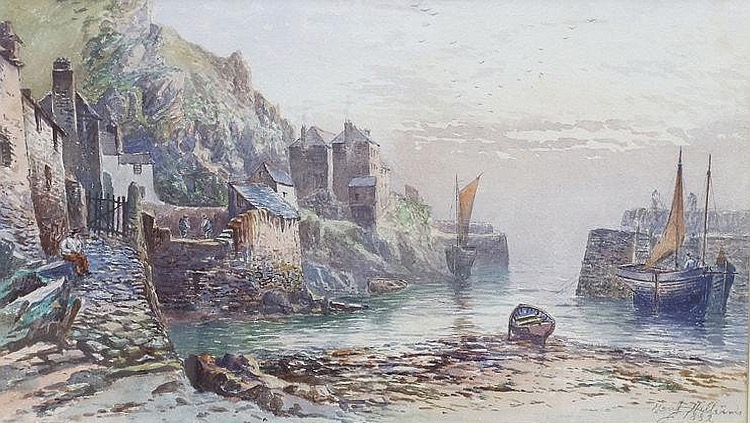
My trawl through the newspapers did not stop with the British Newspaper Archive, for I also searched for references to Polperro in the American version, Newspapers.com, and the Australian Trove, each of which yielded some gems. In addition to the exhibition reviews, one of course learnt much from the various articles about the issues affecting Polperro in each period. There were endless disputes about getting an adequate supply of fresh water to the village, and there were serious problems with the disposal of sewage and rubbish, with Jonathan Couch’s daughter, Bertha, commenting that the River Pol was “the only sanitary servant and refuse collector which the place has ever been rich enough to employ.” Fresh sewage in water used for washing both fish and clothes was clearly unsatisfactory and there were constant outbreaks of disease, particularly amongst the children, and yet it was only in 1939 that a new sewage system was installed. Until then, the river and the harbour were used as dumping grounds, and the American, Elmer Schofield, whilst quietly working away close to a breakwater early one morning in 1913, had a pail of night slops thrown over him! There are still references to Polperro youngsters emptying rubbish bins into the river in the 1950s, and Frederick Cook was sufficiently annoyed by tourist litter louts to do a series of satirical paintings of their behaviour and the impact of this upon the landscape.
In 1904, an issue arose, which caused ferment in Polperro – it was an issue on which fisherfolk and artists were completely united and where all three of the then artist residents of the village – Edward Ertz,
Herbert Butler and John Reid – were actively involved, becoming members of what was referred to as the Polperro Defence Committee.13 The furore was caused by the Admiralty’s decision to hold speed trials on a mile stretch of coast just off Polperro and to erect huge zebra-striped corrugated iron marking posts, some seventy feet high, at either end of the run, with one of these being on a beautiful section of cliff on the Lansallos side of Polperro in full view of the village. As far as the fisherfolk, who were already experiencing ever-lessening catches, were concerned, the passage of warships at extreme speed was likely not only to drive away the schools of migratory fish, but also to result in nets, crab-pots, and even boats, being damaged by the wash. As far as the artists, and all who enjoyed or stood to benefit from Polperro’s natural beauty, were concerned, the huge, ugly marking posts, akin to towers, erected on some of the most beautiful cliff scenery in the area, were a complete eyesore that ruined the vistas all around, particularly as one of these “ghastly galvanised iron abortions” was right on the cliff at Polperro itself. Despite the outcry, the speed trials occurred and the marking posts remained, albeit somewhat improved aesthetically. Even still, in his seminal article on Polperro’s attractions for the artist in the Art Journal in 1910, Herbert Butler blamed the Admiralty for “disfiguring” the village with its “hideous” steel posts.15 However, Polperro now regularly hit the headlines as dreadnought after dreadnought broke new speed records, and Polperro boys, knowing the names of all the boats, itched to join the Royal Navy.
More successful were campaigns in the 1920s to save the villages’ distinctive stone bridges from being replaced by ferro-concrete ones and to acquire sections of the local cliffs for the National Trust to prevent development thereon. In addition to the sections of cliff on the Lansallos side acquired by public subscription, Angela Brazil and Herbert Butler’s sister, Nellie Carstairs, acquired sections on the Talland side, which they subsequently bequeathed to the National Trust. By the 1960s, the major issue was traffic congestion, which was eventually solved by banning most traffic from the village and installing a huge car park at Crumplehorn. This has meant that Polperro has remained far less spoilt than other Cornish beauty spots and its ambience can be enjoyed without fear of being mown down. Many of the haphazardly placed properties, with their outside steps and first floor porches or with their extensions held up by ancient uneven wooden props, that have been painted countless times by artists, remain remarkably unchanged, as do the narrow streets, with alleys and courts and steps leading this way and that. The River Pol still dances down the valley, probably cleaner than ever before. The two harbours are also little altered, and, due to the acquisitions by the National Trust, the whole is still set in “a gem of Cornwall’s most rugged rock scenery”. Hopefully, in the future, the village, in addition to promoting these delights, will also start trumpeting its astonishing artistic heritage and find a venue where this can be displayed.

Polperro books
I hope the above snippets give you an idea of why the last three years has been such an exhilerating time for me and why I have managed to write over 600 pages on this subject. The details of my new Polperro books are as follows:-
Polperro – Cornwall Forgotten Art Centre – Volume One – Pre-1920
(ISBN 978-0-9955710-1-3) (256 A4 pages, price £24), and
Polperro – Cornwall Forgotten Art Centre – Volume Two – Post-1920
(ISBN 978-0-9955710-2-0) (346 A4 pages, price £28)
£50 for the pair – postage £3-50 per book
best obtained from David Tovey
E-mail : toveyd53@gmail.com ; Tel : 01566 784687