Stranger than art

It’s 3am and Venice is quiet and cool. I stumble out of bed, pull a t-shirt over my head and grab for my macbook. Propped against pillows, I search for the link, my eyes squinting and unfocussed despite thick lensed glasses. I’m not a morning person, never have been, and three o’clock is just about as morning as you can get. Beside me, Adrian offers help – ‘Do you want me to get my laptop?’ – while I click and open up the live-streaming page of the Riverview Funeral Home. ‘S’OK,’ I manage to mutter, but it isn’t. It’s two minutes to eleven in Australia, but nothing is happening on my screen. Did I miscalculate the time difference? 

‘No, I double-checked,’ says Adrian. Of course he did. He’s an arch double-checker, never quite trusting his more haphazard wife. So why am I still staring at an empty page? My heart races, my brain is a fog. And then, suddenly, we’re in and I watch the unreal, slightly gut-wrenching spectacle of my sisters, one by one, filing into the chapel for my mother’s memorial service. They’re smiling, chatting, laughing, enjoying the rare and novel experience of actually being in the same place at the same time. The service is about to begin and I’m not there.

The view from our flat in Venice

I tell people about the conscious decision I made last October to visit my mother while she still knew who I was, while she was still on her feet, while we could still do things together. Pointless to wait until she’s dead or dying, I said, but still, the temptation to book a flight and join my sisters has been great. In the end the choice isn’t mine. I simply can’t afford the consequences of Trump’s stupid bombing of Iran. 

Our trip to Venice has been booked since autumn last year, so we go ahead. We’re there for the Biennale Art Festival, the one that the critics love to hate. We spend three days taking it in. It’s vast, covering most of Venice and the two main sites of the Giardini and the Arsenale are packed with innovative, immersive installations that sometimes grab hold of the senses and mess with them. Around a hundred countries take part and, as modern artists typically like to challenge or subvert aspects of their own cultures, these exhibitions give a unique insight into national stereotypes and norms as viewed from the inside. Some of the art is simply beautiful, clever or shocking and easy to grasp. The wow factor is high. Other exhibits are just baffling, or so bizarre I find myself laughing at the absurdity. But it’s never boring, always surprising. What else can keep you entertained for six hours at a stretch?

And Venice is such a gorgeous city to be in. Our second floor flat is in a relatively quiet area between the Giardini and Arsenale vaporetto stops, overlooking the spot where the Grand Canal becomes a lagoon. I say ‘relatively quiet’ because there’s a woman with a foghorn voice living somewhere behind us and she seems to come to life around midnight. We know some other people from Eastbourne, also there for the Biennale, and we meet for dinner on Friday night to exchange views and stories.

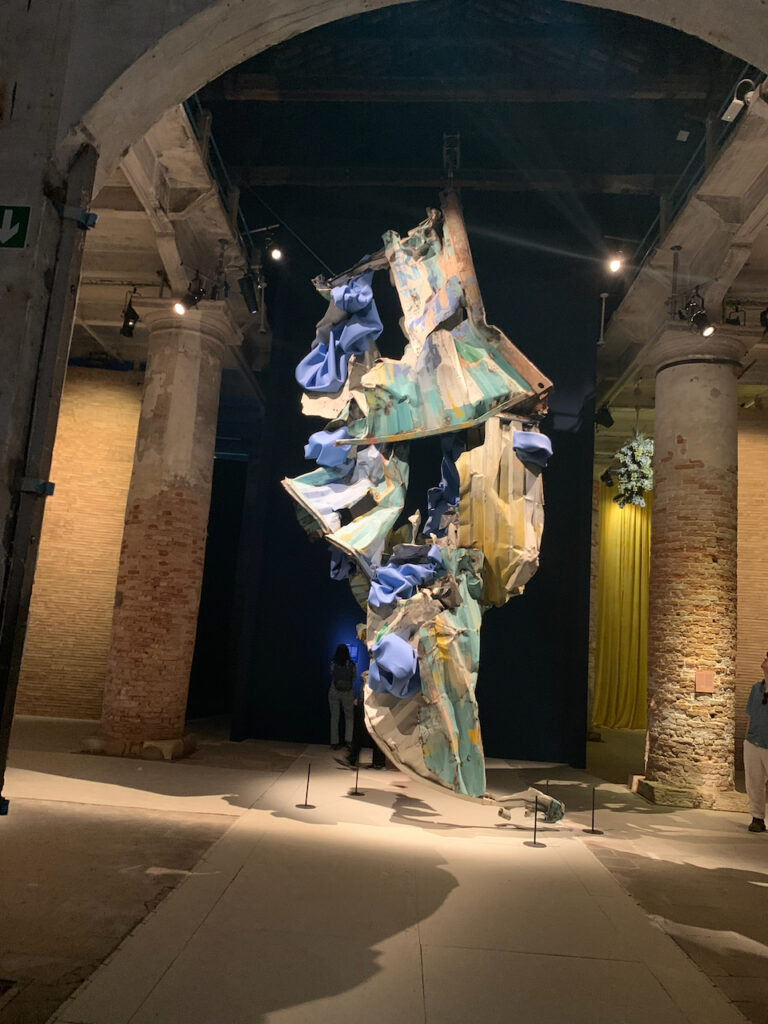
Two installations in the great hall at the Arsanale
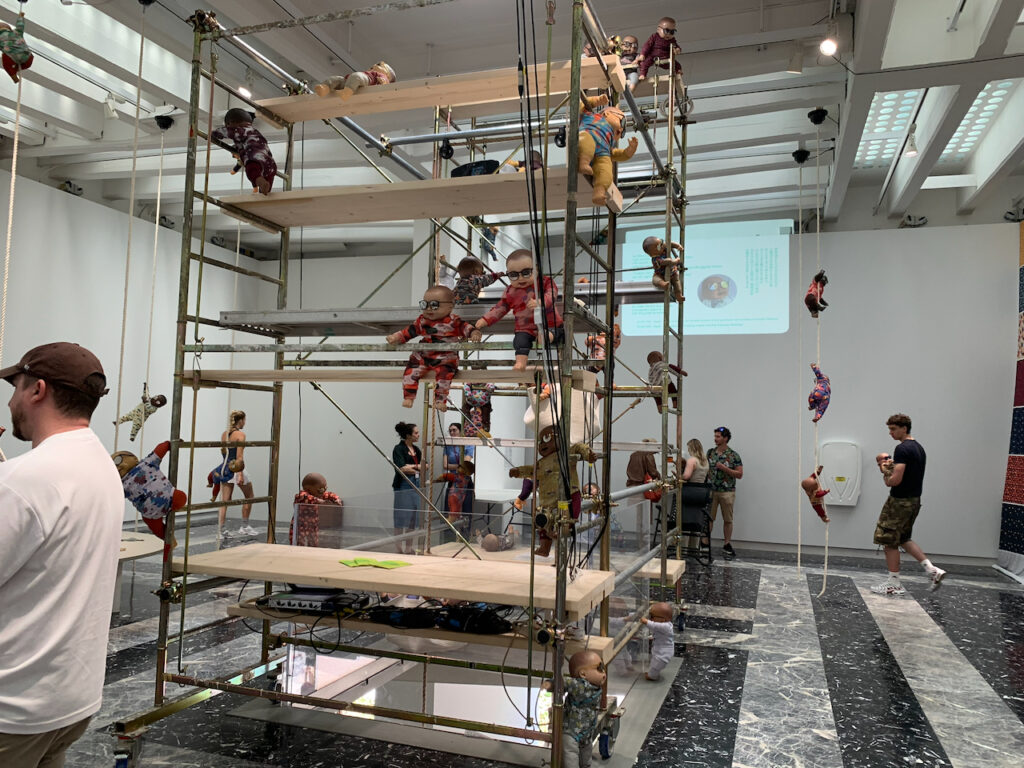
The Japanese Pavilion – guests were encouraged to cuddle baby dolls ???
The stunning Indian Pavilion

‘Sorry to intrude,’ says a woman at the next table, ‘but have you seen the Austrian exhibition?’ It’s the one everyone is talking about: the one with the naked woman upside down inside a bell and another swimming in urine. Our friends shrug. What can you say? It’s closed when we visit, ‘due to illness’ and we’re not surprised. The bell woman causes herself physical pain whenever she does the donging and goodness knows what lurks in the urine. I’m relieved. But we’re sorry to miss the Netherlands Pavilion. Only a few people are allowed in at a time and the queue is endless. ‘We’ll come back,’ we say. But when we do, it too is closed.

The Scrovegni Chapel in Padua

On our way from Venice to Verona, we stop off in Padua to take in the Scrovegni Chapel covered floor to ceiling in Giotto paintings. These, so the historians say, mark the beginning of European realism in art or, rather, a rediscovery of the realism of the classical era. Interestingly, Giotto’s everyday scenes of Mary and Joseph’s life seem real enough and quite genuine, whereas the religious scenes e.g. Jesus ascending into heaven, look forced and false. 

Verona captures our hearts and senses immediately with its architecture ranging across two thousand years. We walk and walk, climb steps and towers, visit the art collection in the Castelvecchio, eat in charming restaurants and listen to opera in a palace. Our accommodation is pokey and hosted by a large young man who doesn’t much like getting up to deliver breakfast, but it’s very central and we spend little time there. 

For my birthday, Adrian intended surprising me with a Rossini opera in Pesaro (R’s birthplace) but there isn’t one to be had until later in the month. So, instead, we come home to Sussex and see the perfect Rossini opera at Glyndebourne – the laugh-out-loud-funny Il Turco – on the one dry day of the week. Sometimes, things just fall into place. 

Verona from the Castle San Pietro
The garden scene at Glydebourne

And now we have a eucalyptus tree in our garden waiting to fall into place for my mother. Alex and Kate will join us at the weekend and in the ground it will go. I couldn’t sleep after the live streaming of her memorial service. It was just too weird watching my family watching me in a video recording of my eulogy, hearing their own reflections on the woman we all feel so differently about, wondering about the conversations that took place afterwards in the mild winter of Yamba while I lay in bed in Venice’s summer. It was days before I could stop the live stream in my head. 

But, somehow, having the tree in our garden, knowing it will soon be planted, knowing we can mark the death of my mother in a way that’s physical and real, has brought calm. I keep thinking: ‘Mum would love this’, can’t get past the idea that she’d still want to be here. But maybe I’m wrong. Maybe, finally, after almost ninety eight years, she was too tired to keep going, worn out, happy to rest. And maybe, it’s selfish to still want her to want life. My own fear of the inevitable. 

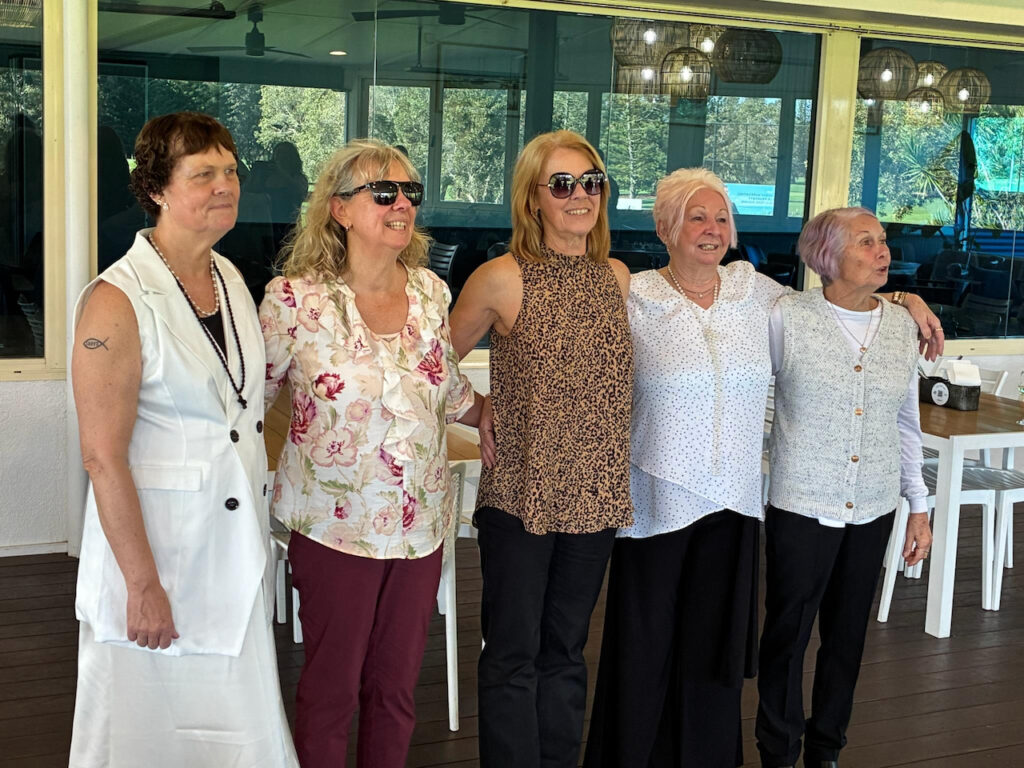
My sisters, together for the memorial service
Mum with our son, Alex

Celia Vasquez Yui’s installation in the Giardini’s Central Pavilion
One of the artworks in the Ethiopian Pavilion
The Nordic States Pavilion
A German exhibit in a wonderful old church
Opera in Verona
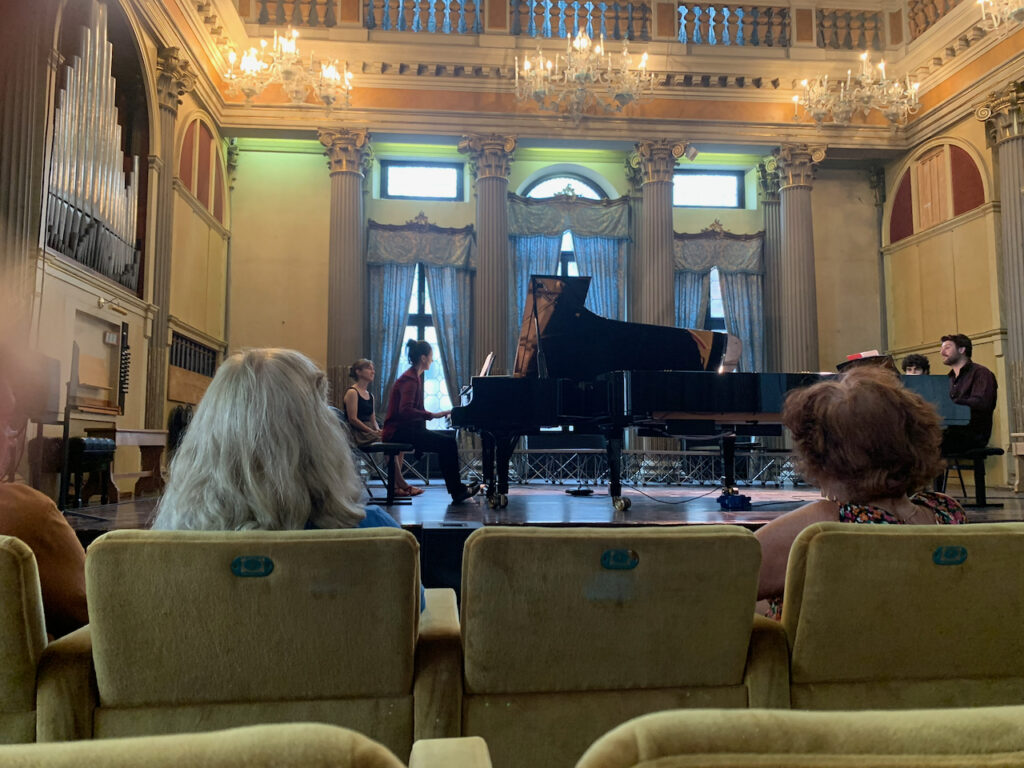
Concert at the Marcello Conservatory of Music

Ending the story

This week, I discover that have not been long-listed for the Curtis Brown Discoveries award. Surprise, surprise. There were over 3,000 entries so what were the odds? And, anyway, rejection is beginning to feel almost comfortable. I see the subject title in an email – your submission . . . – and can barely be bothered to open it. I feel a familiar dull thud in my stomach and then put it out of my mind; get on with something else. Still, I suppose I should question my continued pursuit of publication in the face of failure. ‘You have to be thick skinned,’ I agree with a writer friend of mine. But of course, I’m anything but.

Mum and Adrian in 2022

I mention this because it’s easier to talk about the frustration of trying to get the attention of publishers than to talk about the thing that has been taking up most of my headspace over the last ten days. After a rapid decline, my mother died this week at the age of 97. My own emotional reaction has left me drained, slightly unhinged and just a bit bewildered. Because of this, I keep putting it out of my mind (like all those rejections). But I know, at some point, I’m going to have to deal with it.

The dining room as a door painting production line

Our usual rhythm of life has been interrupted lately by the renovation of our bathroom and the subsequent redecoration of the bedroom. I’d forgotten just how exhausting sanding and painting can be. We do these things ourselves because we don’t like having other people in the house and, anyway, we know we can do the job better than they can. And at less expense. I’d like to say we work particularly well together, but we don’t. We’re both of us rather exacting and it means several days of two tired grumpy people struggling to be polite to each other. 

However, we’re also sensible enough to take time out, walk the downs and remember that there’s a whole world outside of that one disrupted room. We meet the new resident of the recently converted art studio on the development site next door. He’s the subject of a conspiracy theory circulating about the developer’s tendency to develop by stealth. The conspiracy, like so many, turns out to be founded on a piece of misinterpreted information. We like our new neighbour – he’s a pleasant academic and keen cyclist – and Adrian offers to take him on some of his favourite cycling routes. 

The Cuckmere Valley

Then our neighbours take us on an eight and a half mile walk that they particularly enjoy. It starts in the pretty village of Alfriston, carries on around the winery of Rathfinny, then descends to the Cuckmere River valley and back to our starting point. It’s a perfect day for it and the best of distractions. Spring has definitely sprung and brought with it clear blue skies without a sign of rain. Our water butts empty and our new plants look forlorn. The evergreen climbers we planted to cover an uninspiring fence refuse to raise so much as a new leaf. “Until it rains,” they say, “we’re on strike.” The terrace pots look like chicks that have fledged too soon. But later in the afternoon, we finally get the soaking we’ve been waiting for. Not just a bit of drizzle, but a proper downpour. 

The middle of Kent is a long way to go for a short play, but this is what we do on the evening I have news that my mother is semi-conscious and failing fast. I quickly respond to the message and return my attention to the toga-ed Pontius Pilate, performing on the tiny stage in the medieval Ellen Terry Barn. The one-act drama by Michael Punter is an imagining of the man’s recall to Rome; his explanation of why he did what he did and why he is what he is. 

2025

All the while, my brain flicks back to my mother being what she is: a very old woman, single-minded and always determined, who has finally lost her fight. “I’m not giving up,” she tells me on the phone, a few months before she dies. But then she loses the language to articulate the feeling and the decline is rapid. It’s as if, without constant repetition, the story no longer exists and nor does she. After all, what are we, if not the stories we tell? 

It’s probably why I keep writing. 

A lot of weather

Our last few days in La Palma bring a change in the weather : high winds that threaten to blow the washing off the room terrace and damp cloud over the mountains. Adrian is keen to do a walk from the hikers’s refuge of El Pillar, a meeting point of several paths high up in the mountains. A place where intrepid long distance walkers can cook a meal and spend the night. By the time we park the car, the temperature has dropped by thirteen degrees and wisps of cloud are falling (yes, falling) through the trees to the ground. 

El Pillar refuge

We’re in a forest, largely protected from the weather, so when we climb out of the tree shield and hit the open path, we’re not prepared for what comes. We round a corner and walk into the full force of a strong biting wind that lashes cold rain into our faces. Ahead, a young couple pause, consult and then walk on, but after another half an hour, they stop. We exchange grimaces and, by unspoken consent, the four of us head back down the hill to the refuge where we huddle in a shelter to eat our picnic.

Our final walks are in my favourite place of Cubo de la Galga. I love the ravine with its tall trees strung with weeping vines, its laurel forest and meandering path that finally emerges onto the Mirador de Somada Alta.

We take the shorter pathway up and find ourselves clambering up a slippery stone slope with a gradient like a steep staircase; a staircase with no treads. It’s a tricky climb up and, if the apprehension on the faces of the descenders is anything to go by, an even trickier climb down. 

Despite the change in the weather, I’m not glad to be leaving. The island has a relaxed joyous quality that slows the pulse and puts a smile on your face. Back in Eastbourne we’re greeting with fog so thick that when I run along the promenade, I can see nothing beyond 25 meters. People loom eerily out of the mist and the sea hisses invisibly over the shingle, like a soundtrack without the film. It’s cold and wet, but, happily, there are plenty of distractions. 

View from our roof terrace in Santa Cruz

At my writers group, I attend a lecture on script-writing given by the playwright, Michael Punter. It’s both enlightening and inspiring, full of tips and amusing anecdotes. He sets us the challenge of writing a one act drama based on a well-known character. Then there’s an Arts Society lecture on the history of opera, another truly uplifting afternoon. Later in the week, we join in the play reading of Ibsen’s ‘The Wild Duck’, which we make an absolute mash of, not understanding the Norwegian culture, or Ibsen’s satirical take on it. 

This chimes with a point made by Michael about the early performances of Chekhov’s plays in Britain. They fell flat, never raising so much as a smile. It wasn’t until a puzzled director watched the plays performed in Russia, that he understood what was missing: the English translations missed the subtleties of Russian social status. This is something I talk to a translator about – a university friend of our son who translates from Spanish and Portuguese into English. She pays us a visit with her delightful two year old and, in between games involving pots, spoons and uncooked pasta, we talk a little about the challenges of translating not only a language, but a culture that makes sense to the reader or viewer who knows nothing about it. It needs to be made relevant, so that the audience can not only see it, but feel it.

From Cukmere valley to the Seven Sisters – Walk on A’s birthday

While we enjoy all these distractions, the sun comes out and we find ourselves having pre-lunch drinks with friends on the terrace. Adrian even gets out the sun umbrella. Of course, it’s still very early spring and we’re at the mercy of the wind. From the north and it’s cold again. From the west and we get the rain. After living in Britain for almost forty years, you wouldn’t think I’d get caught out. But I do. While the sun shines, I liberate the geraniums from the green house only to watch them being battered by an onslaught of cold wind and hail. A South African friend of my mother-in-law (long gone) once told me how puzzled she was by the British obsession with weather. 

‘It’s always the first topic of conversation,’ she said, ‘and sometimes the only one. They complain about it, they joke about it, they argue about it. They seem to find it endlessly fascinating.’ And then she lives here for several years and she gets it. Now, she not only hears those conversations, she feels them. Deeply.


La Palma

With no forethought, we manage to perfectly coincide our trip to La Palma with the Santa Cruz de La Palma Carnival. It begins on our arrival and continues for the next ten days. It’s pretty crazy. We walk downhill into town – and it is very downhill (there are only two directions on this island: up and down) – and take in the marching families, percussion bands, brass bands and bizarre array of costumes. Each day brings a different spectacle.

One of our favourites is the day of the wigs. Thousands of people crowd the narrow cobbled streets wearing enormous wigs in green, pink, red, colours you may never have thought of, or otherwise balancing carparks, beehives, colour televisions or metre high palm trees on their heads. Everywhere the music plays; everywhere people sing, dance, laugh and have a thoroughly good time.

The highlight of the carnival is Los Indianos day. This celebrates the return of Canary islanders from South America (mostly from Cuba) in the late 19th and early 20th centuries. Why are they celebrated? Because, so the story goes, they brought back great wealth to the island. How they made this money is difficult to discover and nor is it, apparently, the point. The point is to dress up in white and cream – period outfits with loads of lace, linen and jewels – put on your best hat and have one big noisy joyous party. 

Oh, and of course sprinkle everyone you meet with talcum powder. Don’t ask me. We just go along with the vibe and have a whole lot of talced up fun. 

In a very un-PC touch, various folk appear with blacked up faces, padded bosoms and bottoms and brightly coloured, full-skirted dresses. And if that isn’t bizarre enough, these overtly buxom costumes are mostly worn by men. Apparently this is all about celebrating the emancipation of the African slaves of the Americas, but if any of them ever came to the island with the Indianos, there is little sign of them now. 

But there’s more to La Palma than the carnival. There are endless bi-directional hiking paths, the two directions being (you guessed it) up and down. And when I say ‘up’, I mean a gradient that falls little short of mountain climbing. The island is one big cluster of volcanoes rising straight out of the Atlantic Ocean. And not all of them are extinct. The last one erupted in 2021, lasting for 85 days and wiping out an entire town and two villages. 7,000 people were evacuated and the lava flow covered an area of 3.5 by 6.2 kilometres. Today, the area is a black wasteland.

The crater and lava flow of the 2021 eruption

The plethora of hiking ways look innocuous on a map but none of them is a stroll in the park. The easy woodland walk of Cubo de Galga – a gorgeous trek through a tree covered gorge – has us gaining 300m in height in just over an hour. The highest point on the island is the Roque de Los Muchachos at 2,500m above sea level and, yes, some crazy people hike all the way up. We pick up the path towards the top where we climb just 400m in elevation along the 4kilometre ridge. On route, we pass one of the largest collections of astronomical telescopes in the world – pristine white domes mushrooming incongruously out of the black basalt. 

Mirador de Time

We drive the endless hairpin bends around the north of the island, walk down into the valley of Fuente de Caldera, complete with ancient carvings. Sitting on a terrace, we eat scampi and salad in the charming remote village of Garafia, famous for its tea wines – not made of tea but aged in the wood the local tea pines. We find the best mirador on the island high up on a mountain just north of Tazacorte. Mirador de Time. Cheerful staff serve good food on the terrace and we have a spectacular view of the most recent of La Palma’s volcanic craters. 

Back in Santa Cruz on Sunday, the town is all but deserted. There is little reminder of the Carnival apart from the unnerving downhill walk on cobbles and flagstones still covered in talcum powder. They might as well be covered in ice for all the grip they give us. But without the crowds, we discover the town anew, taking in the charm of the winding streets, the impressive architecture of the plazas, the churches, the traditional houses with their pretty wooden balconies. We also discover a rarity, just on the edge of town: a path that travels neither up nor down but follows the edge of the ocean and continues for the duration, amazingly marvellously flat. An old coast road.

Of course, we’re not supposed to be here. There’s a barrier and a fence (already breeched) to keep the public away and we soon discover why. On one side the path is eroded by the sea; on the other it’s strewn with large chunks of rock that have fallen from the towering cliff. We look above our heads and note how easily one might be squished. And then we carry on. The novelty of walking on the level is too good to be resisted. And we’re not the only people there. We round a corner and find a series of ad-hoc dwellings, all tucked into the cliff and made of salvaged wood, metal and . . . old car tyres. We stare at a roof of tyres for several seconds and then give each other a look of recognition. What better protection from a fall of rocks than a thick layer of rubber? 

The old coast road

In an open cave, lies an old man in a bed. We don’t want to stare but this isn’t a sight one sees every day. We assume he’s asleep, but as we return, there beside him is a man placing food onto a table. The old man is too ill to get up and this person has come to feed him. Or so it seems. Several cats have also appeared and they sit by the bed waiting. This good samaritan is expected. 

As we climb back up the hill to our house, I think about the juxtaposition of the Carnival and the old man prostrate in his cave. A few hundred metres away, he’d have heard the music playing, he’d have heard the voices of thousands of people dancing, singing, partying. What would he have been thinking? And what on earth is he doing there? Suddenly being covered in talcum powder seems like one of the least bizarre elements of life on La Palma. 

The north of the island
The St Antonio crater in the south
The serene walk at Cubo de Galga
Fitting in on Los Indianos day

Bjork and the balloon

World events have become so dispiriting and, let’s face it, just a bit scary, that I don’t even want to write about life right now. Bury myself in fiction. That seems to be the answer.

Martin Rowsen at The Lamb with his ‘cartoon’ of contemporary politics

Or a podcast interview with George Monbiot reiterating his values of justice, kindness and respect. A and I listen to it over lunch and we both cry: Yes! This is what the world needs but . . . but . . . well, you know the rest. Even if you read the news with one eye closed or through the gaps between your fingers (like I often do), you can’t escape the fact that it’s greed and brute force that are running the show. 

‘So how was your Christmas?’ The standard question as we attend various social functions at the end of the season. Ours was rather dominated by a dog and a balloon – not necessarily problematic in themselves, but when one gets inside the other on Christmas morning, the solution is going to be protracted and expensive. The dog returns from the vet, temporarily subdued by drugs, and the hungry humans tuck into a delicious brunch cooked by our son, Alex. 

Some of us, with adolescent brains, like to put cryptic clues on the tags of our presents to each other. I’m pretty pleased with a reference I make to a 1984 Bjork shampoo commercial on my musical daughter-in-law’s card. ‘But I was only two years old in 1984!’ she protests when I explain what it refers to. Not that I saw it myself back then. It was probably only shown in Iceland at the time but, by now, someone has posted it on Youtube. Have a look. It’s pretty funny and the reference to roadkill has to be the weirdest selling point for shampoo ever. We carry on opening presents and my son gets his own back with a clue to a biography of Tom Stoppard – his present to me. If you breakdown Tom’s surname into ‘stop ard’ it makes sense but I fail miserably to join the dots. 

After a chilly walk, it’s tea and mince pies and then Alex cooks paella with wonderfully inventive and very tasty accompaniments. Our visit has prompted the ordering of their new house into cosy liveable spaces and, most importantly for us, a very comfortable guest bedroom. Having last seen it packed to the ceiling with boxes, I’m amazed at how roomy it actually is.

Our next family event is the annual lunch hosted by Adrian’s sister. It’s become a bit of an institution, this day in January, and everyone in the immediate family is there (apart from our daughter in Copenhagen). Three generations crowd into the house and we all talk for Britain. For some of us, this is the only chance to catch up face-to-face and we’d be lost without it. We also find ourselves unusually busy with social events in Eastbourne. It feels like we’re gradually becoming a mark on the map. 

So, there’s much to be grateful for in a world that gives the impression of disintegrating. And we always have Australia if the far-right take over Britain. I know that sounds paranoid, and I’ve always dissed the doom-mongers, but at the start of 2026, I feel like I need a backup, even if it’s only a psychological one. 

“For earth’s days and nights are breaking over me

The tides and sands are running through me,

And I have only two hands and a heart to hold the desert and the sea.

What can I contain of it? It escapes and eludes me

The tides wash me away

The desert shifts under my feet.”

(The Moment, Kathleen Raine.) 

Winter at Eastbourne