I’m sitting in bed drinking tea and messaging our son Alex in Australia when the phone buzzes in my hand and there he is, smiling and looking well against a backdrop of blue sky and palm trees. He and Lia are in Yamba, northern NSW and have just spent the day with my 95 year old mother, my sister and her husband and he fills me on on how they all are. Mum is still on her feet, walking unaided and, although she repeats herself, is engaged and full of chat. It’s good to hear.
Alex outside the house in Brisbane where he was a baby
They’re off to Brisbane where Alex and Lia were both born, where Lia’s family still lives and will spend Christmas with them on the Sunshine coast. After that, plans are altering. They’d intended flying to Cairns to visit the Barrier Reef, but after tropical storms, both the airport and Port Douglas are under water.
Our daughter, Kate, is also out of the country so, for the first time ever, we’re having Christmas day with friends and I’m not cooking! Of course, we’d rather our offspring were with us, but this lack of responsibility goes a long way towards compensating. And we’re not the only ones amongst our oldest friends who are having a non-traditional Christmas. Penny and Geoff are in Peru and Sue and Greg in Brisbane have already had their family Christmas and will spend the 25th happily doing nothing.
I think of Christmases past, the different forms they’ve taken, and remember that small window in time between large family gatherings and the start of sharing Alex and Kate with other people. And I realise it was very small indeed: a total of one Christmas when it was just the four of us together in Falmouth, my favourite of all, I think. But then images flash into my mind of Kate and Alex as children, the excitement of opening presents, the fun of mince pie making, school carol services and setting the treasure hunt on the Malvern Hills for the family to do the next day. Then there’d be aunts, uncles, grandparents, cousins all sitting around the table together and I’m glad they have those memories.
Christmases of the future will be something else again, perhaps more akin to the sort we had back in Australia in our twenties. With a bit of luck, we’ll share some of them with Kate and Alex and their partners, but if not, then that’s OK too. I agree with Steve Turner, although for rather different reasons, that Christmas is really for children.
Whatever you’re doing, I hope you have a very happy Christmas and, please, let 2024 bring a bit more humanity into the world.
Christmas is really for the children – Steve Turner
Christmas is really for the children.
Especially for children who like animals, stables,
stars and babies wrapped in swaddling clothes.
Then there are wise men, kings in fine robes,
humble shepherds and a hint of rich perfume.
Easter is not really for the children
unless accompanied by a cream filled egg.
It has whips, blood, nails, a spear and allegations
of body snatching.
It involves politics, God and the sins of the world.
It is not good for people of a nervous disposition.
They would do better to think on rabbits, chickens
So, we’ve finally taken the plunge, we’ve bought a house, set ourselves on the road to once more being responsible grown ups. It’s exciting and, weirdly, also scary. This is it, I think, sedentarism after almost two years of being on the road with never a weed or a window repair to get in the way of the fun. It was inevitable, but somehow it’s still taken me by surprise.
With the beginning of December, Christmas sneaks up on us and insinuates itself into every aspect of our lives. There’s the Croquet Club Christmas lunch and award ceremony to which we take friends, Marianna and Ray. It’s at the Eastbourne Golf Club and Marianna walks bravely into the clubhouse using a stick and eschewing all offers of arms, only weeks after a total knee replacement. She looks bright and pretty, smiling and chatting (although that knee must hurt) and it’s a pleasant relaxed event with good food, a rapidly executed raffle (the best kind), short speeches and, in no time, Adrian’s up on the floor officially receiving the Carter Cup, now engraved for posterity with his name.
Daily, we have a jolly Christmas carol played on the piano and messaged to us by great-niece, Elise. Then there are cards to write and presents to buy for Alex and Lia to take to family in Australia. On their way back from Brighton, where they’ve been visiting Lia’s aunt, they stop in Eastbourne for lunch. We spend several happy hours together, including a visit to the Turner Prize exhibition, but it’s obvious that, with work pressure and preparing for their flight on Thursday, they’re both a little tired. I know the sunshine and rest will do them a power of good and I’ll enjoy picturing them, with more than a touch of envy, in that brightly lit vast open country that we so recently left.
Checking out each other’s life drawings
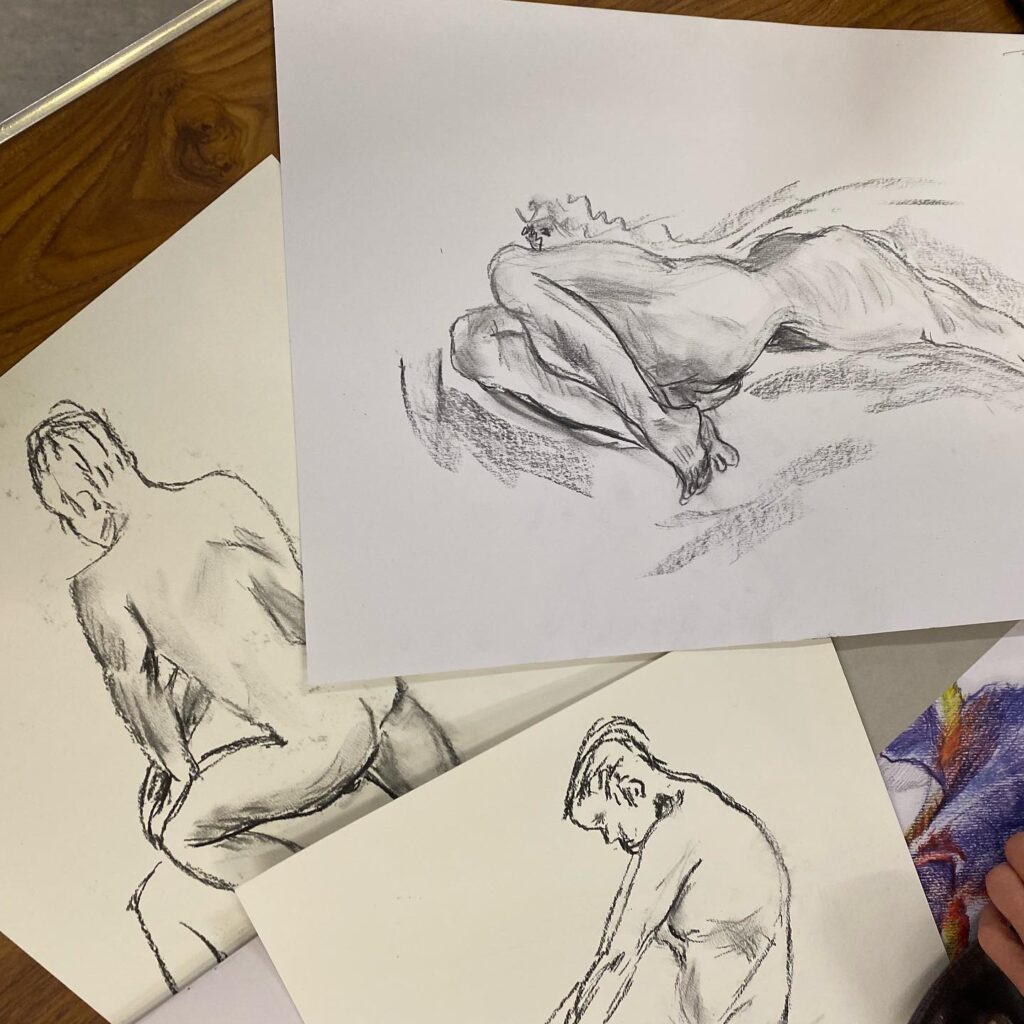
Our Christmas life drawing session is really just life drawing with added mince pies and the two hours pass with their usual focus and energy. Our model is what people used to call ‘statuesque’ i.e large and curvaceous with a wonderful carriage of her body, a way of holding her head that makes her look queenly (if that’s an adjective). She’s a delight to draw. As we wish each other a happy Christmas, one of the members invites A and me to drinks and it starts to feel like we’re becoming part of the social life of this town.
On Monday evening, I drive to Hastings for the Writers’ Christmas bash, while Adrian cycles to his first meeting of the local play reading group. In keeping with the season, they’re reading the fourth of Dorothy L Sayers’ twelve one act plays entitled The Man Born to be King. It also happens to be their Christmas party and Adrian returns having thoroughly enjoyed his evening playing Simon/Peter with a west country accent and drinking red wine with an American couple who’ve just renounced their American citizenship in general disgust with the country of their birth. Having spent years living in Italy they’ve plumped for retirement in Eastbourne and we take this as a good sign.
Hastings Writers Group Christmas party and awards
Talking of Italy, Hastings Writers’ Group patron, Simon Mawer, still lives there. He gives a brief talk at our Christmas do and presents the year’s prizes. I remember his novel, The Glass Room, which I read shortly after its publication, making a huge impression on me, mostly because of the audacity of placing aesthetics at the heart of a sinister story of the Nazis in Czechoslovakia, where they enacted their obsession with ethnic biological differences. I have a brief chat with him and it’s nice to be able to tell him in all honesty what a mark his novel made on me. (http://www.simonmawer.com)
Adrian has just booked the delivery of all our belongings and this house-buying thing is beginning to feel real. It’ll be fun to see our stuff again, but what will it be like after almost two years in storage? I imagine mould, broken glass and a general terminal squashedness of everything. Then I remember those homes full of possessions in Gaza, in the Ukraine, blown to smithereens and family members with them and my concerns seem a little trivial. Anyway, if the current stalemate at the Cop 28 summit persists, we’ll have much more to worry about.
We listen to the Reith lectures with Professor Ben Ansell discussing our democratic future. He says he’s optimistic, but it feels to me that our democracy is so broken it’ll take more than a bit of optimism to put it back together. It’ll take a whole new electoral system and which of our two main political parties is going to suggest that, I’d like to know?
We take a walk around the marina after dark and look at the crazy Christmas lights residents have strung all over their townhouses, sometimes climbing up four floors. They obviously ‘know it’s Christmas’ (thanks Mr Geldoff for the ubiquitous supermarket ear-worms), but do they know the state of their own country? I’m convinced that it was a lack of proper engagement, a general apathy, that got us Brexit, that kept our appalling government in place while they killed off the aged during the pandemic and now allows them to continue to trash human rights. Oh, dear. That’s the trouble with being back in the UK: my semi-dormant strain of irritable cynicism is growing back with more vigour than ever. It can’t be stopped – there’s just so much nourishment about.
This week I’m more than a little cheesed off. After a gloriously musical weekend, I’ve been hit by a cold bug and I’m not impressed. As one of those people who constantly boasts that they don’t get ill, I’m dumbfounded to find myself in exactly that state for the third time since being back in the UK. This is unprecedented: this is my usual quota for around ten years not seven months. So I blow my nose for the millionth time and demand to know: ‘What sorcery is this!?’
Glyndebourne house with theatre additions on right
But to return to the music. Via a rather convoluted set of relationships, I’m offered two tickets to Glyndebourne for a performance of Don Giovanni. They’re second row seats, right in the middle, barely a bassoon length from the orchestra pit, so with little hesitation, we decide to grab them. It’s an afternoon performance and we arrive in time to look around the grounds, but it’s so cold that we soon scurry indoors. Not that the bar area is much warmer – Glyndebourne’s definitely a summer venue – but, once the theatre is full of bodies and the doors are closed, the temperature gradually rises and we settle in our coats to be absolutely stunned by this brilliant performance.
Everything about the production is captivating – the versatile tiered set, the young pure clear voices (neither of us is keen on too much vibrato), the imaginative direction of the supporting cast and, of course, Mozart’s music. If Mozart imagined Don Giovanni as a debauched amoral lecher, then the director, Mariame Clément, realises this imagining in its most base and physical form. In the build up to Don Pedro’s dramatic ghost scene, she has D G not only eating an enormous cake, but sitting in it, bottle in hand, filthy and unkempt, as he demands more food and wine and boasts of his sexual conquests. There’s no moral ambiguity in this scene. When he’s finally plunged into hell, depicted by actual fire on the stage, no-one questions whether or not he deserves it, not even Don Giovanni.
Eastbourne Choral Society concert (All Saints Church)
And then, on Saturday afternoon, I attend concert of the Eastbourne Choral Society, quite a change of qualitative pace but also highly enjoyable. They perform Handel’s Alexander’s Feast with a small ensemble of period instruments, a professional tenor and a young soprano and base who, although still students, have good, strong, mature voices. The choir sings with enthusiasm and competence. It’s well done.
After the interval (not a cup of tea to be found!) comes Puccini’s Mass, a religious piece that is distinctly operatic. He composed this at the age of eighteen, while still a student and, in fact (so I’ve read) it’s the last piece of religious music he ever wrote. Having heard Verdi’s ‘Aida’, he promptly dropped the family tradition and turned his talent to opera.
In the hands of this choir, the mass sounds difficult but perhaps that’s because, accompanied by nothing but a piano, it comes across as if it’s still in rehearsal, a bit disjoined, lacking in confidence and cohesion. They seem to plough their way through it, rather than enjoy it, not altogether at ease and not always together. But what do I know? I’ve never sung in a choir and anyway, I’m far more familiar with Puccini’s operas than I am with this piece of music.
Autumnal scene at Glyndebourne
One of the added delights of the afternoon is the conversations I have with various members of the audience, who like so many people in Eastbourne, are open and chatty. I learn that the young woman on my right sings in another choir and I agree to come to her Christmas concert. In front of me is a recent retiree who is keen to move back here from Oxford, where she’s been working, and is disappointed that the house she’s just viewed isn’t suitable. To my left are a couple who volunteer with a local charity supporting victims of domestic violence and, while I queue for a non-existent cup of tea, I learn that the man in front of me saw the Rolling Stones perform in a local pub in the 1960s.
Our November Art Society lecture is something of a surprise. Val Woodgate talks, with accompanying pictures, about art with an overtly political message and discusses how much influence such artwork has on national or international views. Picasso’s Gernica is a prime example. Its anti-war message is so blatant that the tapestry reproduction hanging in New York’s UN Headquarters was covered by a curtain when Colin Powell, standing in that time honoured place, presented the American case for invading Iraq. Ironically, Picasso’s painting also inspired young British men to dash off to Spain to help with the fight against fascism.
Picasso’s Gernica
The lecture also covers art works that attack racism, poverty, and other forms of discrimination during which Val, like Chris Aslan before her (see previous blog), makes no attempt to hide her leftist views. This is the surprise. I’m used to lecturers carefully minding the political sensibilities of their older, middle-class audiences (and let’s face it, NADFAS members are traditionally Conservatives) so I’m pleasantly surprised to find out how well this lecture is received by Eastbourne group members. I look at the faces drinking tea and my picture, as if on a computer photo editor, gives it’s horizon a little tweak.
Applicants for Admission to a Casual Ward, 1874 (oil on canvas) by Samuel Luke Fildes (1844-1927)
The ceasefire or ‘humanitarian pause’ in Gaza continues with daily lists in the press of those released from captivity on both sides. Half of the freed Palestinian prisoners are children and I can’t help wondering in what way these children are terrorists, I mean what is their crime? And then I read about two Israeli teenagers, held hostage by Hamas, returning home to discover that their mother is dead and their father missing. Children and babies form a major component of the dead in Gaza. One of the Israeli hostages is a baby. Remembering my own son and daughter as children, my brain short circuits on the notion that anyone would want to destroy these young lives. I blow my nose for the millionth and second time and realise I’m crying.
The Eastbourne Arts Society’s special interest day is very interesting and rather special. The speaker, Chris Aslan, a highly personable and good looking young man, keeps us all riveted, even during the post lunch dead zone, when Arts Society members are wont to nod off. The thing is, Chris has actually lived his subject – traditional textile making along the silk, wool and cotton roads – spending fifteen years among the nomads and other locals of the Central Asian ex-soviet Stans. He loves the place and his enthusiasm is infectious.
He’s also unapologetically political, critical of the powers who’ve exploited and, worse, tried to eliminate, the indigenous populations. He’s particularly damning of the British Empire and their commandeering of Indian cotton (amongst other things) and, aware that many of the membership are likely to be habitual Tory-voting Telegraph readers, I wonder how this will go down. Well, brilliantly, it would seem: in the break, the female members queue up to pay this charming man twenty pounds for a signed copy of his latest book, ‘Unravelling the Silk Road’.
Talking of books . . . as we have no television, we spend our evenings reading. We’ve also developed a taste for radio dramas and are more than ready to take in the plays offered at Eastbourne’s theatres. The tiny Grove Theatre that lurks beneath the library, stages David Hampshire’s Funny Turns, set in a 1935 boarding house, with a script that’s a little slow and acting that’s generally very good. Humour tends to date, but the innocence of these jokes keeps them fresher than those that liked to indulge in tedious sexist or racist innuendo. A couple of the actors are ‘off the telly’ but we’ve never watched ‘Hi Di Hi’ or whatever it is they’ve appeared in, so can’t really appreciate this stardom.
Funny Turns – David Hampshire
A few days later, we’re at the Devonshire Park Theatre to watch The Haunting, a ghostly play based on several of Charles Dickens’ short stories. Again, the play is very competently delivered and this time by just two main actors – my goodness the lines they have to remember is a feat in itself! I enjoy the scenario, but the script has the two protagonists engaging in such a lot of arguing about whether this or that phenomenon is or isn’t otherworldly that the play ceases to be the slightest bit scary.
‘Also, the apparition is a bit too solid,’ says Adrian in the interval and it’s true that I find myself wondering how on earth she’s going to get all that white make-up off, rather than feeling any thrill or fright. However, the woman sitting next to me is on the edge of her seat chewing her fingers and sucking in her breath, so the white arms, blackened eyes and projected voices, obviously works for some.
I’ve recently contacted a Play Reading group, not because I fancy myself an actor but because I’d like to be better at reading out loud. Andrew, who runs it, is apologetic. He has all the members he can use right now, and what’s more, the majority of them are women. Adrian expresses interest and I can see that it’ll be him who joins the group and not me. I can’t even deride this as sexist favouritism as the simple truth is they have a surfeit of women and need more men. It’s my ballet career all over again.
Martin, our life model this week, has wonderful muscle definition and a pleasing way of posing. ‘And his feet!’ exclaims Laura, ‘don’t you just love his feet!’ And yes, he does have very nice feet. These, like hands, are bits of the body I usually leave off the page or draw in some vague blur, but Martin does inspire me to try harder. ‘Told you,’ says Laura as she looks over our efforts. And I have managed a couple of passable feet. Happily, from where I sit, the foreshortened pose Martin adopts also obscures his head. Well, it’s the head or the feet, with me. There’s no way I can manage both in the same fifteen minute drawing.
And then I hear from a former campaigning friend in Devon, who talks about vigils for peace and a ceasefire in Gaza and my heart sinks. Of course, it’s lovely to hear from an old friend, but the subject of Gaza has no light in it. A few days ago, I read that the Al-Shifa hospital was being bombed and evacuated of its extremely sick patients because it was sitting on top of a Hamas head quarters. Today I read the IDF have found a tunnel but presumably it hasn’t given them what they want, because they’ve announced further attacks on hospitals and refugee centres.
A photo my son found on Wikipedia
Palestinians are told yet again to evacuate and move away, but where to? Neither the Israeli government nor Hamas care what happens to them. They’re simply in the way of the determined efforts of two extreme factions to destroy each other. Meanwhile the leaders of both sides are safely elsewhere. Then I read the dispiriting fact that the richest 1% cause more carbon emissions than 66% of the poorest people in the world and I remember why, for a year I stopped engaging with the news and gave up campaigning. Like impotent rage, the protest marches and peace vigils achieve nothing. But at least, like recycling waste, these feel like sane acts in what is an increasingly insane world.
Lazy Sunday on the prom in EastbourneA winter walk on the South Downs
This week I have a lovely email from Sarah to let me know that Patrick is thankfully back to his buoyant self after a horrid bout of Covid. She also remarks on the very cultural time we’re having and, when I come to review the last week, I see that it’s true. I think we’re packing in as much as we can before once more entering the ranks of responsible homeowners, that time consuming very British occupation. On that front, with all parties keen to progress, we should be exchanging contracts sometime in the next fortnight.
And so to cultcha . . . I have a very enjoyable evening with my writers’ group in Hastings, followed, on Tuesday, by a rather whimsical meeting of a poetry group I’ve found. Our host, red-haired and charmingly ageless, welcomes me into her very warm and comfortable house with aristocratic grace. The members are diverse in every respect but age – seventy to eighty, I’d say – some needing sticks to move about. Everyone settles into what I suspect is the same seats they choose every meeting and our host introduces this month’s ‘theme’, harvest, with absolutely no reference to the theme as a topic for poetry.
Dave Rice – charcoal and rubber
This sets the tone, and one by one, the members read their chosen poem with no discussion of the poet, the form or style of the poem, the period or any other context. ‘Yes, isn’t beautiful,’ says our host each time and moves onto the next reader. So I’m rather pleased that I’ve chosen one of Edna St Vincent Millay’s rather subversive takes on ‘beauty’ (printed below) which is followed by a small silence, a request to read it again and one or two brief comments. This encourages me to try to introduce some discussion of one of the other poems, Robert Frost’s ‘After Apple Picking’, but this is cut short and the meeting concludes with a little homily, suggesting that one can be over-analytical about poetry and miss its intrinsic beauty. Well . . .
This week’s life-drawing model is definitely beautiful. Bobbie settles her supple young body into wonderfully relaxed shapes that seem as instinctive as they are aesthetically pleasing. The group buckles down to two hours of intense concentration and some of the results are stunning. Many of this group have spent years at art college and some are in fact professional artists, so I suppose it’s unsurprising that my own efforts look clumsy by comparison. But this is an activity that I enjoy in the doing, and I vow to be more adventurous, experimental in the future and not bother about what comes out at the end.
With Marianna at the Congress Theatre
On Friday, we meet Marianna and Ray at the Congress Theatre for a performance of Giselle. I danced in this ballet when I was eighteen and the first notes of the overture prompt tears (of what? – nostalgia, visceral memory, loss?) to well up in my chest. But as the curtain goes up, I note the rudimentary scenery, the less than brilliant technique of some of the corps de ballet, the rather reduced cast and, in the space of a few seconds, emotions are forgotten and my critical hat is firmly in place. Happily, the lead dancers are a cut above and the glorious second movement is a pleasure to watch.
‘I still don’t know what Hilarion is supposed to have done wrong,’ says Adrian as we walk from the theatre to our car and, for the first time, I see this ballet as a very odd mixture of feminism – the spirits of betrayed women dancing male betrayers to death – and the worst kind of misogyny – beautiful powerful women, must of course, be witches.
A wing-surfer taking advantage of strong winds after the storm
The much anticipated Storm Ciarin hits Eastbourne overnight so we miss the worst of it. Or so we think. After a day of inactivity, we head out for a run and soon discover that battling straight into the teeth of the wind and the horizontal stinging rain that comes with it, is absolutely no fun at all. We have a day’s respite and then the sky opens up once more, dropping buckets of water on the windscreen as we drive to Charleston Farmhouse near Lewes. We’ve arranged to meet Sue in the carpark and agree, by mobile, to wait for a pause in the deluge, and make a run for it into the house.
In Duncan Grant’s bedroom (spot Adrian in the mirror – arty or what?)
The sitting room at Charleston Farmhouse
Charleston is the home of Clive and Vanessa Bell (the latter a painter and sister of Virginia Woolf) and the artist, Duncan Grant, who co-habited in one of those interesting, sometimes tragic, arrangements that, at least in retrospective accounts, became synonymous with the Bloomsbury group. The house is itself a work of art, with prettily stencilled walls, painted fireplaces and every door panel, shutter, piece of furniture and window casement decorated with flowers, animals, shapes and people, all by Vanessa. There are rugs handmade by Duncan Grant’s mother, lampshades and jugs by Quentin Bell, hand painted china by Grant and Bell and personally designed fabrics, not to mention numerous paintings and sketches. It’s all absolutely fascinating and engrossing and the highlight of the house, as Sue predicts, is Vanessa’s large airy studio.
Vanessa Bell’s studio
This is a beautiful, highly evocative room which is maintained exactly as she left it: photos and news cuttings pinned to the mantlepiece, cupboards full of bottles and jars, paints and paintings everywhere. There’s a chaise longue that belonged to the artist, Walter Sickert, armchairs by the fireplace, hand painted mugs and pots. It’s as if Vanessa has simply stepped out momentarily and will soon be back. My tummy rumbles and I realise we’ve been in the house for two hours.
As we make our way through the rain to the cafe, Adrian says: ‘It’s amazing to think that they didn’t actually own that house.’ And it is. Sitting in the 21st century, it’s difficult to imagine investing so much time, money and creativity into a rented property AND being confident that one wouldn’t be told to leave it next month. Nor can I imagine our landlady being terribly impressed with us if we started stencilling all the walls or decorating her door panels . . . but then we’re not Vanessa Bell and Duncan Grant.
“Still will I harvest beauty where it grows” Edna St Vincent Millay
Still will I harvest beauty where it grows:
In coloured fungus and the spotted fog
Surprised on foods forgotten; in ditch and bog
Filmed brilliant with irregular rainbows
Of rust and oil, where half a city throws
Its empty tins; and in some spongy log
Whence headlong leaps the oozy emerald frog. . . .
And a black pupil in the green scum shows.
Her the inhabiter of divers places
Surmising at all doors, I push them all.
Oh, you that fearful of a creaking hinge
Turn back forevermore with craven faces,
I tell you Beauty bears an ultra fringe
Unguessed of you upon her gossamer shawl!
Vanessa Bell’s bedroom with portrait of her son, Julian
For the past month, I’ve been immersed in the life of Frances Partridge, via her diaries of 1939-75. Her writing is so wonderfully vivid, reflective and critical, her values so close to mine (or so it seems) that she’s starting to feel like a friend. Of course, her world, peopled by the ageing but still colourful Bloomsbury group members and more than the occasional aristocrat, is nothing at all like mine and there’s also the hard truth that if we happened to meet say, at a drinks party, I’d probably be dismissed as part of that rather despised category of people marked ‘harmless but dull.’ She was nothing if not critical. And yet, there are so many ways in which I strongly relate to her.
One volume of the diaries, Frances on the cover
That I agree with her sentiments about war, religion, social inequality, reactionary views and their corollary, social smugness, is perhaps unsurprising and hardly unique. But there are also many little things about which I agree wholeheartedly, like her scepticism of the word ‘loyalty’, her irritation with those who have no opinions (or too little conviction to ever express them), her rather impatient assertion that the delivery of information about oneself or one’s favourite subject is NOT the same thing as conversation, so that I find myself surprised to remember that not only are our social and educational backgrounds miles apart, but also our generations. She’s roughly the age of my grandparents. Although unlike them, she managed to live for an entire century – a Victorian who saw in the new millennium.
But enough of Frances . . . This week, the London Philharmonic returns to Eastbourne, bringing with them the pianist, Samson Tsoy, playing Beethoven’s 3rd Piano Concerto. This is my second favourite of Beethoven’s concertos and I anticipate the performance with great excitement. But as Tsoy moves from a brilliantly played first movement to the second, I’m somewhat puzzled. This exquisitely poignant combination of notes will generally have me in tears, but this pianist plays the piece sooo ‘largo’ that I find my emotions falling through the spaces between them and disappearing into the basement. Why?
His encore, one of Schubert’s impromptus, is joyous and prompts a search on Spotify for the rest of the bunch. A and I settle down with a glass of wine to listen, and a couple are so familiar to me that I feel sure that Alex must have played them at home while he was still at school. Sure enough, he confirms that his teacher, Mrs Hancock, had him play them: ‘I never loved them, but I think she thought they were good for me.’ She probably did. As finger work-outs go, they’re pretty tough.
Part of Barbara Walker’s exhibition
Adrian contemplating Jesse Darling’s instillations
Then there’s this year’s Turner Prize exhibition at the Towner here in Eastbourne, which is producing, as is expected, much raising of eyebrows and clicking of tongues. Everyone I’ve spoken to agrees that Barbara Walker’s beautiful pen and ink drawings of West Indian faces superimposed over the ‘proof of residency’ each of these British citizens were forced to present in order to avoid deportation, is deeply moving and, although it takes me a while, I feel I understand what Jesse Darling is doing with his found bits of steel, plastic, tools, barriers, bandages etc i.e. evoking a world of ‘stuff’ being held together by the sticking plaster of rhetoric and illusion (perhaps). And I can sympathise with Rory Pilgrim’s aims and enjoy his music, but I do keep asking myself: when does documentation become art? As for Ghislaine Leung’s rows of toy washing machines and hoovers, I can only scratch my head.
Samson Tsoy
This week, I have some very welcome chats with friends in other places. Penny is about to take off with husband, Geoff, for a three month backpacking trek around South America, illustrating (as if I needed reminding) how much more intrepid, courageous and tough these two are than us. Sue and I chat as if she’s in the next town instead of on the other side of the world. And I have a lovely email from Joan and Bruce wishing us well with our impending house purchase.
On that subject, it’s interesting that, although mere acquaintances at my drawing class and the croquet club express excitement at our good fortune in finding a house, this same information posted on my ‘sisters’ Signal group, raises nary a murmur. Hey ho. Happily, Adrian has carried out his own survey of the house and found nothing to stop us going ahead. It seems to have been built in the late 1920s and I’m amused to realise that, having started with a regency house, we’ve slowly crept forward through the 19th century to the modern era. Next house: 1960s bungalow? ‘I think I’ll manage stairs for a while longer,’ says Adrian, catching a train to Brighton and cycling all the way back.
Just when we thought our political days were over, we find ourselves joining Alex on a march in London. As we pack into the tube train on the Circle Line, we’re sardined by people of all ages and ethnicities, strangers talking to strangers about the collective reason we’re here: to demonstrate against our government’s support of the relentless bombing and appalling treatment of Palestinian civilians in Gaza. It feels good to be part of a large group that is anti-war, anti-discrimination, anti-arms sales to those who’ll use them to kill ordinary people and their children.
On the march
But, as we shuffle towards Marble Arch, within the press of thousands of protesters, my qualms about the various takes on this ‘reason’ are supported. There are those who insist that this march is anti-Israeli and, although I can understand the feelings – after all some of these people have families in Gaza and the West Bank – I’m personally uncomfortable about some of the chanting. There are plenty of Jewish folk both inside Israel and across the world who are as appalled by the actions of the Israeli Government (and the UK and US governments who support it) as we are. However, the march is peaceful and good natured and we’re glad to be part of it.
Dick Wittington and his cat – St Michael Paternoster Royal
On a very different note, we have two Arts Society events this week. Firstly, an excellent lecture on London’s stained-glass windows and secondly, a tour of the Houses of Parliament. Anna Warrilow’s lecture is far more interesting than I anticipated. I’ve never really ‘got’ stained glass. Although I can appreciate the majestic aesthetics of those large sunlight-filled pictures, their symbolism and history have somehow never lodged with me. But as she talks us through the close relationship between the history of London and the stained glass of numerous buildings – altered, burnt, bombed, rebuilt – I discover a new way of accessing what I’d previously skated over. I now want to spend time walking the streets of London, hunting down her examples and I think this is a pretty good indication of the quality of her lecture.
After the lecture, we mill about with tea and cake and look for conversational groups to join. But it’s a characteristic of such gatherings that people are generally rather insular. They stay attached to their particular friends and take little interest in anyone new. There are, of course, exceptions, and my experience tells me that these ‘exceptions’ tend to be the more interesting element; people with multiple friendship groups, broad interests and lives spent on the move. These are the people I love to meet.
The model for our drawing class this week is another large, awkward man, who has such difficulty adopting the positions Laura suggests that she resorts to various boxes, cushions and chairs to prop him up. Still he fails to look at ease, wears a permanent scowl and constantly snorts through his (obviously blocked) sinuses, saying nothing. Compared to our flexible, dignified actor of the previous week, this man is rather hard work.
Mary Branson’s light sculpture at Westminster at high tide
So to London. On Friday, we take the train to Victoria, leave our overnight bags and head past Buckingham Palace to the National Portrait Gallery, where we spend two enchanted hours and eat a delicious lunch. I can’t resist a side of broccoli salad, cooked al dente and dressed with preserved lemon rind and I make a note to try this at home. One of the fun things to do at this gallery is spot the people you ‘know’ from across the room. There’s George Elliot, Noel Coward, Churchill, Florence Nightingale, Elton John . . .
It’s a pleasant walk to Westminster, the weather ten times better than the forecast suggested. In fact, having come dressed for the cold, I find myself rapidly overheating. Once inside the Parliament buildings, we’re taken on a tour of the various lobbies, the Commons and Upper House, and given a noddy lecture on our own political system. It would have been interesting to hear something of the subjects currently being debated, the business being done, but as I can barely stand to read news reports of what our current desperate excuse for a government is up to, perhaps not. I did learn one interesting fact i.e. that the UK is one of only two nations in the world that have spiritual leaders in their governing body, the other being Iran.
As we finish the tour of Pugin’s building, our guide points out the New Dawn circular window over the entrance to the original medieval commons chamber. Created by artist, Mary Branson, the lights, powered by the tide, represent the incremental steps towards universal suffrage, ending in 1928 when all women were finally given the vote. By the time we leave, the high tide has them all alight and it’s a moving sight.
In the evening we meet Alex and Lia at Dalston for a Vietnamese meal and a night of music performed by one of their friends from Berlin.
Bex performing at Cafe Oto
Using various percussion instruments (many of which she built herself) and voice, Bex Burch creates a unique textured sound which is sometimes rhythmic and melodic, sometimes almost existentially abstract and always personal. She describes her own music as ‘messy minimalism’ and I sort of get that. I’m interested in the broad demographic of the audience and we have an enjoyable chat with Bex’s aunt after the show. If you’re interested, Bex’s music is best explained here: https://www.theguardian.com/music/2023/oct/20/bex-burch-there-is-only-love-and-fear-review-messy-minimalism-that-grooves-hard
By the time we leave the march and head to Victoria, our brains are buzzing with the eclectic nature of our London experience, thanks in no small part to Alex and Lia, who seem pleased to share their world with us. Both are frantically busy with day jobs, creative asides, sorting out their flat for sale, but still they manage to be relaxed and upbeat. On Saturday morning, Alex cooks a delicious breakfast of all the things we love and supplies us with tea he’s bought specially, as neither of them drink it. As we pull into Eastbourne station, savouring the time we’ve spent together, we agree that this is why we returned to the UK, why we’re settling in a place so close to London.
Our old friend, Bill, has died. He and Diane were our neighbours in Falmouth for many years and, along with their opposite number, Sally Ann and Dave, we’ve remained friends ever since. For a while, Bill acted as caretaker for us, while we let out our house for holidays and, whenever I arrived down to visit, he and Diane were my first port of call. The same age as my mother (who met him and adored him), Bill always felt more like a wise uncle than a friend. He loved to talk literature and we spent many happy hours discussing books. We also laughed at some of the more eccentric encounters he had with our house guests. He was infinitely patient, kind and thoughtful.
So Adrian phones Diane to ask after Bill, only to hear that he died the day before. Diane is distraught and we wonder how she’ll manage without her life-long companion, the man she cared for and nursed to the end. She’s a highly capable, independent woman and she has her son, neighbours and friends, but, there’s no doubt, losing Bill will be very very difficult. I think about those times we spent sitting in the front room at Clare Terrace, drinking tea and chatting, Bill with his deep measured talk and Diane laughing, looking years younger than her age. It’s the end of something and I can’t yet work out quite what that is.
Our potential new home
Back in Eastbourne, Adrian and I have put in a ‘cheeky’ offer on a house – the only one we’ve seen that we both liked – and, serendipitously, the owners are keen to move and have accepted it. It’s been so long since we sold the Rectory that I feel as excited as if it’s our first house purchase rather than our eighth. Also, there’s the fun of unpacking all our stuff to look forward to; rediscovering paintings, books, china, old favourites. Then we think of how much we cleared from the Old Rectory. This house we’re buying isn’t quite the downsize we envisioned. ‘We’re going to need another sofa,’ says Adrian just as the exact same thought crosses my mind.
After unseasonably high temperatures, we’ve suddenly been plunged into Autumn. The days are bright, clear and sunny, but oh so cold. After three consecutive summers, we’re not sure we’re prepared for this. In fact, with our winter clothes still in storage, we’re definitely not. Hastily, I buy a padded coat and another jumper and cheer as I discover I’ve at least had the forethought to keep back a pair of gloves and a wooly head band. On Saturday afternoon, we head for Beachy Head and, as we walk back into Eastbourne, we look down at the place where we think our new house is located, sitting tucked into the side of the Downs.
Early morning in wintry Soveriegn Harbour
I’ve been searching for photographs of Bill and, as so often happens with friends who are always there, I discover I’ve taken none. Adrian’s sure he has some and sets about searching his laptop, but in the meantime I come across photos of Joan and Bruce’s wedding, at which new friends, Marianna and Ray, and Sally and Neil, were guests although we didn’t know them at the time. We have Marianna and Ray to lunch and talk a little about Joan and Bruce and their interesting lives. Marianna tells us about the first time she met Joan (pre-Bruce) at Joan’s house in Port Isaac.
They set off to walk the coast path from the house to Polzeath to meet up with their respective partners, who are playing golf at St Enodoc. Neither of them appreciates how far the walk is or just how gruelling, with it’s constant descents and ascents. ‘I took along some biscuits and offered them to Joan,’ says Marianna. ‘“No, thank you,” replies Joan.’ A stunning ex-model, she’s saving her appetite for their lunch in an upmarket hotel in Polzeath. ‘But I tell you,’ continues Marianna, ‘after a couple of hours, we were fighting over those biscuits!’
Sue’s ‘Blue Peter’ cup (compare with previous blog)
I scan my photos of the wedding, but can only find one of Sally amongst the sea of anonymous faces. Marianna and Ray must have sailed by that day undetected and now, here we sit together having lunch in Eastbourne. Adrian’s phone pings and he has a WhatsApp message from our friend Sue in Brisbane. She’s just noticed the startling resemblance between the Carter Cup (won by Adrian at the Newbies’ croquet tournament) and her mock up with plastic, glue and cardboard for the ‘Rectory Cup’, our own tournament in Bratton Clovelly during their visit in September, 2018. She’s right: the resemblance is hilarious.
This sparks another search through photos and I find several that stop me dead: Jenny playing croquet in the Rectory garden, Kate walking on Dartmoor, Wendy at Port Isaac. Oh dear. What a morning for reminiscing! I still can’t find one of Bill and, after obsessive searching, it feels like some deliberate act of sabotage. I email friends who might have one to send me and in the meantime, remember him on that last occasion we saw him, ‘speeding’ down Clare Terrace on that silly trial mobility scooter. It looked ridiculously small for this tall man with his long legs and his large warm heart. ‘Will it go any faster?’ Adrian asks. And there was Diane on the pavement laughing helplessly and calling to Adrian to ‘stop encouraging him!’
The Rectory Cup tournament with Jenny in the foreground and Sue in the centre back
This week, Adrian and I are in training. Each year, the Compton Croquet club holds a competition for Newbies and any unwilling members, like me, are soon shamed into taking part. The constant refrain, ‘it’s just a bit of fun’, circulates around the club house, but we all know this is a lie. On the day, at least some of the competitors will be taking this event very seriously indeed.
Sunday morning at the Hastings Literary Festival
As luck would have it, life has intervened to clash with our croquet days and we haven’t so much as picked up a mallet for two weeks. So, like sixth-formers approaching their A-levels, we do a spot of last minute cramming. It doesn’t do me much good and I’m approaching Friday with a lump the size of a croquet ball in the pit of my stomach.
On another front and more passively, we take in some talks at the Hastings Literary Festival followed by a wonderful concert of the London Philharmonic Orchestra featuring Mendelssohn’s violin concerto. This is a favourite – we know almost every note – but it’s so much more exhilarating played live. We also drive to Portchester Castle and, hungry for lunch in a village that has no cafe, find ourselves at St Mary’s church which sits in the grounds of the castle and boasts a tea room. Here, we’re given the best sandwiches we’ve ever had, a bottomless pot of tea and a wonderful tour of the church interior.
Our exuberant guide, Clare, at St Mary’s
Our guide, Clare, is a well informed and infectiously enthusiastic story teller. The history of the building is fascinating. We hear of subterranean Roman temple ruins, Anglo-Saxon origins and modest Norman additions. We also hear of its schizophrenic life during the Reformation, when Lord Cornwallis concealed a Catholic alter and a statue of Mary that could be pulled out of cubby holes when no-one was looking. The church, considered too unimportant to destroy, happily carried on in this way for many years.
Clare also shows us the tiny stone coffin of a Roman baby, found in the foundations of the castle wall and dated to around 200AD. Portchester itself has always been a garrison, housing thousands of French prisoners, for example, during the Napoleonic wars. But we spend so much time eating sandwiches and listening to Clare, that our tour of the castle is necessarily rather cursory.
Then it’s D-day at the croquet club and my heart is in my mouth. All and sundry continue to tell me that ‘it’s only a bit of fun’ but if you play as badly as I do, it’s hard to find the laughs. My only hope is to end of the afternoon, with something on the score board. I manage not to be annihilated and, at least two games are close. But by the time the last round is over, my head is aching and I don’t much care what happens next.
But then we realise that Adrian, having won every game he’s played, will be a finalist! There’s a murmuring around the club. This wasn’t at all predicted any more than it was expected that the favourite would be knocked out of the match. After tea and delicious cake, we all pour out of the club house to huddle in the cold late afternoon light and watch the final fight.
Adrian wins!
It’s a closely fought match and, with one more hoop to win, Adrian blocks his own ball and his opponent takes the point. At the next hoop, there’s a dispute and the referee is called. He judges the ball playable and the match goes on. By now, the light is fading and the spectators are shivering with cold. Then, on the eleventh hoop, Adrian lines up well, his opponent mishits and Adrian scores. He’s won the tournament and there are shouts of delight, both from those who are genuinely pleased for him and from others who are just glad it’s over and they can now get warm.
‘Well, there’s a turn up,’ says one of the older members of the club to me. And it is. This wasn’t supposed to happen and, probably because of that, it seems doubly pleasing. After many pats of the back for Adrian, we say our goodbyes and gratefully turn up the heating in the car. We drive back to our flat and set about making supper and, as we finally sit down, we discover that we’re both absolutely shattered and incapable of doing another thing.
The London Philharmonic in EastbournePortchester Castle with St Mary’s in the corner of the grounds
This weekend, Alex and Lia train down from London to share in the excitement of a live performance of Tubular Bells. For me, this is pure nostalgia. Back in the day, everyone I knew had this album, the iconic cover with the bent pipe suspended over a turbulent sea as much part of teenage decor as the candle in the Mateus bottle. It was a musical turning and talking point and we played it so often it became lodged in our brains. If I could sing or play an instrument, I could reproduce all the main themes to this day, but what I hadn’t appreciated was how much this music had influenced our ten year old son.
Lying in bed, plugged into his walkman, Alex listened to an old cassette recording that Adrian had made to take to Papua New Guinea. We’re amazed that the tape survived into the 90s. This album, Alex tells us, opened his mind to the surprising realisation that there was more to music than the classical, choral and pop sounds of his early life. It set him on a road of discovery and his passion for finding and making new music has never diminished.
Now, I wonder what sort of parent I am to have taken this long to learn something so important about my son. But then, that omission also speaks of the young boy who would have hugged this revelation to himself, probably not knowing quite how to articulate it, particularly to his very non-musical parents.
On the beach with Alex and Lia
The first half of the programme is a little ‘ho hum’. On the Pavilion balcony, we talk about the music Mike Oldfield wrote with David Bedford and agree that it never quite reached the heights of that first composition, written when Mike was just nineteen years old. And it would seem everyone else agrees. After the interval, an audible wave of relief rises up from the packed auditorium as, finally, the first few notes of Tubular Bells ring out from the piano. It’s what we’re all here for.
Of course, the ad hoc overdubbing technique used by Mike Oldfield doesn’t readily lend itself to live performance and there are some variations, not to mention a bod bobbing up and down whose sole job it is to keep the main guitarist supplied with the constant changes of instrument: Spanish, acoustic, electric guitars and, of course, a mandolin. But, in the main, it’s all there. Hairs stand up on the back of my neck and Alex confesses to being close to tears. Only Lia is unmoved. Growing up in Brisbane, this music never made it into her orbit. It isn’t part of her history.
Nature inspired Art Nouveau
Talking of history, this week Adrian and I attend our first lecture of the Eastbourne Arts Society. Ian Gledhill, a speaker, actor, designer and theatrical producer, gives an exceptionally engaging and entertaining talk on Art Nouveau architecture, that nature-inspired rejection of the classical and the gothic. It’s an architectural style that barely featured in Britain and certainly one I now know a great deal more about than I did before Tuesday. Ian’s delivery is a master class in public speaking, not only fluent, amusing and strongly narrated, but also full of interesting facts about buildings and people that he pulls effortlessly out of his head. After a fascinating hour, I want immediately to sign up for one of his tours of Belgium or Prague.
My arty week is completed with two lovely hours of drawing. Our male model doesn’t seem altogether at ease and he tells me afterwards that he hasn’t modelled for some time. His poses look a little uncomfortable, a little too flat and I find myself distracted by wanting to provide him with a pillow and, given the drop in temperature, a heater.
Finally, sitting, he fits . . .
I also realise that, for some reason that probably isn’t particularly interesting, I’m more in tune with the female figure. I can’t get this man’s proportions right. Maybe it’s just that he seems too big for my A3 drawing pad. I find myself with a head or foot disappearing off the edge and I make a note to buy some larger paper. But none of this detracts from my enjoyment of the class, the focussed creative atmosphere in the room, the sharing afterwards of other people’s interpretations.
Gradually, I’m surrounding myself with all the things I enjoy, while Adrian cycles off for miles along country lanes. It pulls us in different directions. Adrian loves the peace and space of the countryside; I need the sea and the stuff of town. It makes finding the right house a little tricky. The only one we’ve seen to date that might satisfy us both is beyond our budget. ’We’ll get there,’ Adrian says as we drink our tea in bed. I’m not sure he really believes this, but it draws a line on a rather overdubbed discussion, the small spool of tape on loop.