The changing harbourscape
Artists provide a fascinating record of the changing harbourscape of Polperro’s two attractive harbours. Frederick Golden Short depicts the ruin of the Salvadori Pilchard Factory just before it was pulled down in 1888 to make way for ‘The Foresters’ Hall’. This was a fascinating building erected by the Order of Foresters, a friendly society caring for the sick and providing insurance for the fishermen. On the ground floor, the original fish-curing facilities were retained. On the first floor, there was a large meeting room, which was not only used by the hundred or so members of the Order, but also made available for concerts and lectures. On the second floor, two artist studios were provided, thus evidencing the importance placed on the art market even at that juncture.
At much the same time, the Teglio family from Genoa took over the old Consona Boatyard, which had been depicted by Harry Williams, Polperro’s first resident artist, in 1882, and erected thereon a Pilchard Factory – now the Polperro Heritage Museum. In c.1910, a new red corrugated iron roof was installed on this property, providing a striking new colour note in the harbour scene, which artists could not resist. On the Talland side of the Inner Harbour, there were originally two lime-kilns that would have been stinking industrial zones, but artists tended to portray them as a picturesque castle-like feature. In the early 1890s, these were demolished and the Dunn family of Mevagissey erected a further Pilchard Factory thereon. With its green doors and shutters, this too featured in innumerable paintings. After the demise of the fishing industry, this was converted in the 1940s by architect, William Pierre-Hunt, into the attractive property ‘Warren House’.
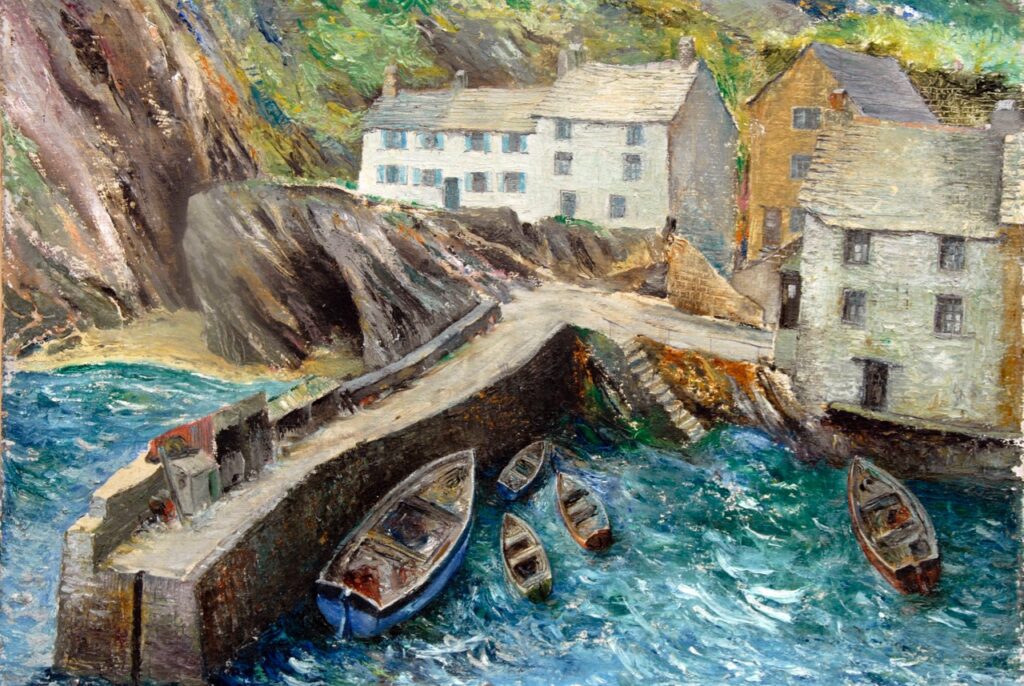
In 1897, there was a complete reconfiguration of the breakwaters in an effort to protect the fleet and the village better during intense storms. The distinctive Inner Quay, beloved by artists as it has properties built on it, was reduced in length so as to extend little further than the old smoke-house (now ‘Studio Cottage’), whilst the Outer Quay was extended and a new quay built on the Talland side opposite so that the harbour could be closed off by wooden baulks.
Artists captured too the fluctuating fortunes of the fishing industry. Early depictions show the original clinker built boats and then the introduction, after much devastation had been caused to the fleet in a storm in 1891, of the famous Polperro Gaffer. Artists, like the German Claus Bergen, went out with the fishermen and depict the fleet or individual boats in action offshore, but the most evocative paintings (by artists, such as the American, Elmer Schofield, or the Dutchman, Hendrik Jan Wolter) are those showing, in the immediate pre-WW1 era, the large fleet setting out for the fishing grounds, their red sails illuminated by the setting sun, or, on their return, jostling for position in the two harbours at a time when it was possible to walk from one side of the harbour to the other from boat to boat. Whilst there were still some forty boats operating in the 1930s, this had dwindled to just five when Jack Merriott did a feature on the fleet in 1961. However, two of these boats – One Accord (FY185) with a light blue hull and dark blue bulwarks and Patsy Anne (FY439), with a yellow hull and light blue bulwarks, provided a wonderful set of complimentary colours that artists found irresistible.
Artists’ lives
Ancestry.com has been one of my principal sources, as one soon learns that one cannot trust auctioneers, art dictionaries or even the artists’ own entries in Who’s Who in Art as to dates of birth and death and other related family material. Furthermore, ages recorded in Censuses, particularly those given by females, are not to be relied upon! Whilst there are many well-known names featured in the books, there are also a large number of artists who might have an entry in a Dictionary, but whose careers have not received any attention before. It has been fascinating uncovering the stories of these neglected artists. Perhaps one example will suffice. For quite some time, I was flummoxed by the identity of an artist called just Mrs R.D.Oliver, who had a solo show featuring Polperro paintings at Walker’s Galleries, New Bond Street, in April 1936. She was said to be an Australian, but there seemed to be no listed female artists in this country or Australia called Oliver, who fitted. However, I eventually found that that self-effacing title disguised the wonderfully named Torfrida Lois Acantha Oliver, formerly Schwann and Swan, née Huddart (1874-1961), who had exhibited previously as Torfrida Swan. Having had six children with her first husband, she had married a Naval officer over twenty years her junior, who went on to become a Rear Admiral! However, it is normally male artists, who marry a much younger partner second time around, the record going to Hampden Alfred Minton (1853-1934), whose second wife was forty-four years his junior!

Perhaps the most extraordinary life story uncovered is that of Tom Morton, best known for the series of prints of Polperro scenes which clearly sold well, for they appear with regularity on eBay and, indeed, a set hang in Polperro Village Hall. However, he rarely exhibited his work and, as he only signed it ‘Morton’, auction houses usually misattribute it to other more well-known artists with that surname. His full names transpired to be Harold Thomas Morton (1905-1981) and he was the son of a policeman. In addition to working for a while as a commercial artist, he himself served in the police for a while before retiring due to “ill health”. It appears that Morton suffered from mental issues and he was discharged from the Territorial Army in January 1943 as being permanently unfit on the basis of psycho-neurosis “aggravated by war service”. He arrived in Polperro in 1944, with his second wife, Edith Callen, whom he had married in 1940. His first wife, Ethel Blucke, whom he had married in 1930, had died in 1938, and, for some considerable time, I was flummoxed as to why I could find no record of the birth of his daughter, Mary, during the course of his first marriage. It ultimately transpired that Mary, born in 1934, was not the daughter of his first wife, Ethel, but of his second wife, Edith, which makes Ethel’s death by electrocution in her bath a trifle suspicious! Having divorced Edith in 1953 on the grounds of her alleged cruelty, Morton married Mary Munro, a local guest house manager, in March 1954, having only met her a fortnight before. The relationship only lasted a couple of months before Mary got a divorce on the grounds of Morton’s desertion, cruelty and his adultery with his second wife! This set Morton off on a chain of legal cases against all and sundry, resulting in his bankruptcy, and for more than a decade, he was a thorough nuisance to the courts, alleging a whole range of conspiracy theories. For instance, in 1965, he produced two hundred copies of a 350,000 word book, containing accusations against judges, solicitors, a magistrate, a detective inspector and a doctor, and he distributed hundreds of flyers in the locality.5 It appears that he got back together with the long-suffering Edith fairly shortly after his divorce, remarrying her in 1971. He ended up shooting himself in 1981, having been beaten up badly by a local baker fed up with his constant abuse! Who said art research is boring!
Artists’ models

Over the years, a large number of members of the Polperro fishing community have modelled for the artists. Herbert Butler used his father-in-law, Captain John Pond (d.1912), with his distinctive bushy white beard, on a regular basis for his major oils, and Pond also modelled for Edward Ertz and Frank Heath. Butler and Heath also used a local fisherman, John Edward Minards (1833-1916), as a model, as did the Germans Carlos Grethe and Claus Bergen, and Arthur Romilly Fedden, who was involved at the outset with Butler’s Painting School. However, it is from an article by the Canadian artist, Sophie Pemberton (later Beanlands), who used Minards as a model in 1893, that we learn most about this quirky character.6 She first met John Minards, as he used to “putt people away”, that is to say that he took visitors’ luggage to the station on his handbarrow. When she first arrived, he had just seen off an old gentleman by the train and passed the comment “What a brave old chap one must be to risk going up to London.” Finding that he often posed for ‘artisses’, she found that he was willing to model for her, as long as she gave him the small sum he would otherwise make at his fishing. Whilst posing, he told her stories about his life and beliefs. He had been married three times. His first wife died young in childbirth and his second wife also died prematurely, leaving him with four children to bring up. Then, he lost to consumption his two daughters, one in her teens and one in her twenties. Sophie commented, “It was a great grief to him and yet he was able to say, “After all, it was only one trouble. If they had grown up or married there might have been many.” Some of the beliefs he had seemed to belong to ages past. Accordingly, he told her that wedding cake must be carried upstairs backwards and tied in the left stocking with the right garter and put under the pillow, getting into bed backwards and in strict silence! Clearly, a great believer in witchcraft, he indicated that he had been bewitched twice at school, and told her many strange tales of witches, who changed into rabbits and milked the cows, and of witches as squirrels, who lived in the trees and could only be shot if the gun were loaded with quicksilver. He also told her a horrific story about a sister of one of his wives. She had been on a boat that had been wrecked in a storm on an island off Africa. The natives were cannibals and had killed and eaten all the other crew and passengers, but the chief had taken her as a wife and had had three children with her. However, one day, she managed to attract the attention of a passing ship and escaped, only to see the chief murdering their three children. She returned to Polperro and lived many years after, only was “sort of queer” and never went out very much.

There are also portraits of members of the Puckey, Curtis, Oliver and Mark families. One of the most recognisable fishermen from the 1930s and 1940s was William Puckey, one of twelve children and captain of the aptly named boat The Nine Brothers. He was known as ‘Nelson’ as he wore an eye patch, having lost the use of his left eye when a fork was thrown during banter at the family dining table.
Polperro women were renowned for their knitfrocks (fishermen’s jerseys) and are frequently depicted knitting (and gossiping) on outside sets of steps or in characteristic Polperro porches, where the light will have been better than in dimly lit cottages. Butler also liked to depict lovers meeting under the cover of dusk or fishwives welcoming the return of husbands from fishing trips. Alice Puckey, in the 1891 Census, even described her occupation as ‘Artist’s Model’.
The Roberts Johnson cache of paintings
One of the most exciting finds during the project was the discovery of a huge cache of paintings retained by the daughters of Frederick Roberts Johnson, who was involved with the Polperro scene from 1924 for over thirty years. During the 1930s, Roberts Johnson had considerable success as an illustrator, producing ‘funnies’ for Punch, Everyman, Time and Tide and various Women’s Journals. However, as he tended to use the pseudonym ‘Essex’, his own name is little known. Having left wing views, he also produced copious illustrations for the early issues of The Tribune (founded 1937), but here he used the pseudonym ‘Sax’. Ignorance about his painting output is more understandable, as he never exhibited or sold his work, but his family retain over 250 of his paintings, most of which were executed in Polperro and often depict Polperro subjects. Always keen to experiment, they are in a bewildering variety of styles, in pastels, oils and watercolour, but nevertheless include some very fine work. Volume Two therefore introduces this fascinating collection to the world for the first time.
In Part 3: Polperro Authors and the fight to maintain unspoilt Polperro