“Surely there cannot be another place of such quaint rarity – medieval charm set in a gem of Cornwall’s most rugged rock scenery – unique and inimitable.” (Western Morning News, 12/8/1925)
“Polperro would be hard to beat for strong-smelling picturesqueness…. Inevitably, therefore, it is invaded each summer by long-haired artists, mostly foreign.” (The Bystander, 12/4/1911)
Tackling an untold story
In 2018, I was due to be working with Penlee House Gallery & Museum, Penzance on an exhibition and book on American Artists in St Ives, but, late the previous year, this was cancelled as Penlee were unable to get any funding to bring across from America a selection of important paintings. For once at a bit of a loose end, I wondered if a look at the story of art in Polperro might throw up anything of interest, as I kept on seeing paintings of Polperro going through the auction rooms by foreign artists of some significance. Whereas St Ives had always had an attraction for foreign artists, this was not the case with the other art colonies at Newlyn, Lamorna or Falmouth, and so I was intrigued as to what had made Polperro the Cornish destination of choice for a range of celebrated artists from a wide variety of different countries.
Apart from an excellent article by Donald Adamson in the Cornish Banner on the brief stay during 1939-40 of the Austrian Expressionist artist, Oskar Kokoschka, there has been very little – if anything – written previously on art or artists in Polperro.1 There has certainly been no in-depth research into the manner in which it developed as an art centre and if or when it became an art colony, nor into the range of artists, both British and foreign, who were inspired by its charms nor into the quality or importance of the paintings produced. There has also been no assessment of the socio-historical interest of these works, particularly those that log the changing harbourscape or capture Polperro personalities. Furthermore, if you go to Polperro, you will come away completely oblivious to the fact that it has any artistic heritage at all, and this is the case even if you visit the excellent Polperro Heritage Museum, as this just looks at its smuggling, privateering and fishing history and has no room for paintings. Indeed, you are likely to leave wondering why Polperro seems fixated with Cornish piskies!
Accordingly, I started my research with a blank canvas, and I soon realised why no-one else had attempted the task before, because the source material seemed scant. Given the lack of all year round resident artists, there had been no attempt to form an Artist Society, be it for artistic, social or entertainment purposes. In the pre-WW1 period, there had no moves by a local entrepreneur to set up a gallery at which local artists could display and sell their work. There also did not appear to be a local paper that recorded daily life in Polperro that might give clues as to when artists were in residence. Material from such sources had been crucial in telling the story of the art colonies of St Ives and Newlyn.
What to do? I started by putting ‘Polperro’ into the search engine of the British Newspaper Archive, working on a yearly basis from 1860 onwards. After a while, one picked up the news stories that were worth reading and I began to discover a surprising number of references to paintings of Polperro hung in exhibitions around the country. In this regard, I was, of course, totally dependent on the artist using ‘Polperro’ in the given title of the work or on the critic recognising that it was a Polperro subject. The venues at which these works were shown often proved surprising. I learnt, for instance, that the Bath and West Show, held in a different town each year, could contain as many as 500 paintings on display during its brief run. Soon I started to have a list of artists and dates for their exhibited Polperro pieces, but, of course, the process of working through from 1860 to 1950 (after which digitalisation of most newspapers has not yet happened) was a long and laborious one, but one which I knew from early on would bring copious reward. To this list, I was able to add artists whose paintings of Polperro had come up at auction, albeit it is amazing how many Polperro scenes are not recognised as such by auctioneers, as well as artists who had Polperro subjects in public collections (albeit again, these are often not recognised as such). With this burgeoning list of several hundred artists, I was able to make a start on the story.
The early years
What was the story that emerged? Well, after the visits of the early nineteenth century engravers, Joseph Farington in 1810 and William Daniell in 1823, there is almost a complete blank until the 1860s. But whereas the completion of Brunel’s rail bridge at Saltash is normally thought of as a key date in the history of Cornish art, it had little impact on the ease of getting to Polperro, so that most of the well-known regular visitors to Cornwall in the 1860s and 1870s, such as James Clarke Hook and John Brett and the Bristolians, George Wolfe, Samuel Phillips Jackson and Charles Parsons Knight, never included Polperro in their itineraries. With the link from the main line to the branch line to Looe not completed until 1901, it was too difficult to get to or to get from there to anywhere else. Accordingly, during the 1860s and 1870s, the artists who worked in Polperro tended to be West Country ones, particularly those based in Plymouth – artists such as Samuel Cook of Plymouth, his son, William Cook, Harry Williams, William Henry Pike, William Gibbons, Richard Hoskin, etc.
However, the success in the 1880s of a romantic novel about Polperro’s smuggling past (see Polperro Authors below) and a series of full page sets of drawings of the village in several popular illustrated papers, resulted in more artist visitors that decade, and paintings of Polperro started to be hung with some regularity at the Royal Academy. Indeed, it is possible to contend that there were more paintings of Polperro hung at the Royal Academy in the 1880s than there were of St Ives. Visitors included William Llewellyn (later President of the Royal Academy), Mouat Loudan (who became Head of Westminster School of Art), Frank Short, the famous etcher, and Thomas Gotch and Henry Meynell Rheam, who both later settled in Newlyn. However, the most regular visitors were Charles Boutwood and Herbert Butler, who first came in 1884 but who returned to court two daughters of their landlord, Captain John Pond, eventually marrying them in 1889 and 1892 respectively. Nevertheless, they did not settle in Polperro immediately.

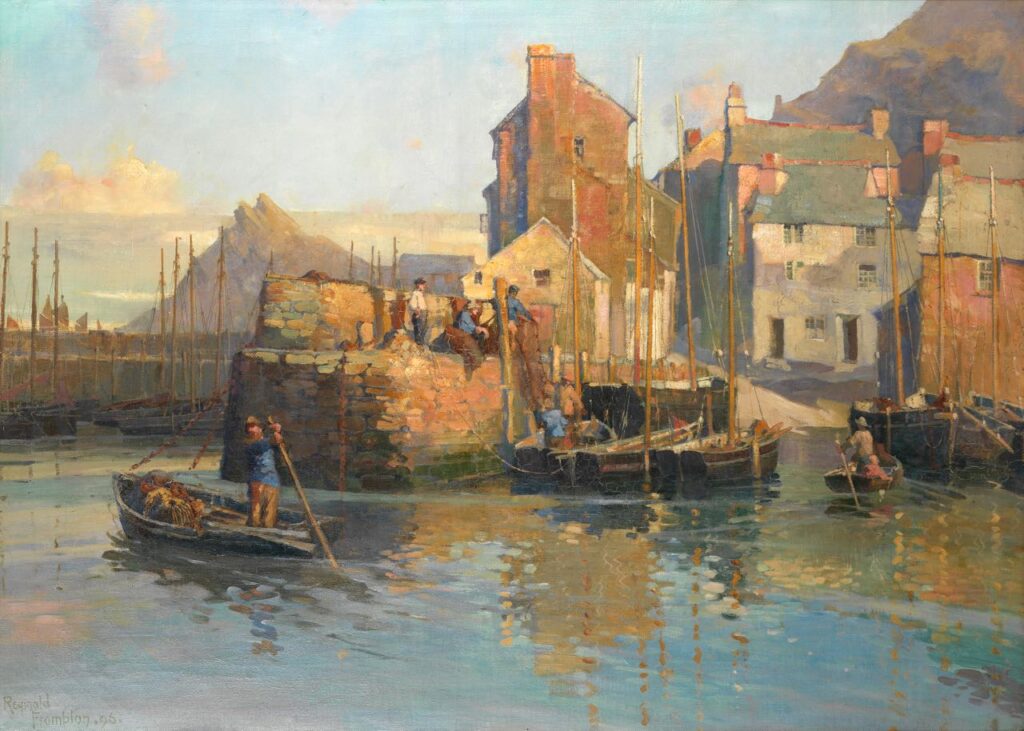
Whilst there seemed a real prospect of an art colony being established in 1889, this did not happen and, despite the odd gem, like the Reginald Frampton work from 1896 that I use for the front cover image of Volume One, the 1890s prove a little disappointing. Whilst Polperro’s encircling hills were an attractive feature in the summer, they did mean that a number of properties did not see sunlight from October to March, and this had an impact on the village’s desirability as an all-year-round residence. It will also have been difficult for artists to have found housing in the narrow confines of the valley away from the noise and smells of the fishing industry. There were water supply and sanitation issues as well that might have helped to put off artists settling permanently in the village. However, Herbert Butler and his wife, Sophia, settled in Polperro in 1900, and he is considered the father of Polperro art, as he remained a key figure in the community until his death in 1931. He produced oil paintings of the fisherfolk, watercolours of Polperro’s harbours and quaint streets, and was also a strong advocate of pencil drawing when he opened a painting school in 1907. In particular, he highlighted Polperro’s attractions as a place for twilight, moonlit and night-time scenes.
Another very regular visitor from 1901 was the Scot, John Robertson Reid, who depicted, in oils and watercolours, the fisherfolk happily going about their tasks, and, in particular, he highlighted how the children were following their fathers’ calling. Unlike Newlyn School depictions of the fisherfolk, Reid never hints at sorrow or bereavement in these works. George Hillyard Swinstead was another regular visitor, whilst Frank Gascoigne Heath, who later settled in Lamorna, and John Anthony Park, who settled in St Ives, were also residents for a few years.
A popular destination for International art students

In the summer of 1894, Auguste Delécluse, the master of a well-respected Paris atelier, brought a party of some thirty female students to Polperro for three months. This was a hugely successful venture, with Delécluse waxing lyrical about the beauty of the location, the variety of subject matter, and the suitabilty of the fisherfolk as models. “An artist need not go out of his way to find material for his brush and pencil as everything is near at hand – there are pictures at every turn. It is simply magnificent in every way and someone wishing for models will find the Polperro children superb and the Cornish fisherman a splendid type of manhood, picturesque and courteous to strangers.” He himself exhibited a painting of Polperro at the Paris Salon in 1895. In 1900, one of Delécluse’s long-term assistants, the American, Edward Ertz, came to Polperro with one of his students, Ethel Horsfall, and they fell in love not only with each other but with Polperro, so that, upon their marriage that year, they settled in the village, and opened a painting school, which, due to Ertz’s Paris contacts, again attracted an international clientele.
In the years 1903-1914, American art students were also very visible in Polperro, as European Summer Classes run by Henry Bayley Snell, who was for over forty years Head of the Philadelphia School of Design for Women, tended to visit the village for at least part of each trip. Snell also ensured that his students’ work was hung, particularly at the New York Water Color Club, where he was President, so that paintings of Polperro by himself, his wife, Florence, also a well-respected artist, and their students became a regular feature of American exhibitions. Quite a number of these students went on to have distinguished careers.
Other major foreign artist visitors
Polperro’s burgeoning reputation in America led to some major American artists including it in their European itineraries. Accordingly, Thomas Moran, “the Dean of American Painters”, who came to Cornwall in 1906 to follow in Turner’s footsteps, ended up preferring Polperro as a subject to Looe, where Turner had painted. Elmer Schofield, a leading American Impressionist, visited in each of the years 1912-4, and George Macrum had a Polperro painting hung at the National Academy, New York in 1914. Other significant foreign artists to visit pre-WW1 include the German, Cornelius Wagner, whose 1910 RA exhibit Low Tide Work, Polperro is owned by Gallery Oldham, and Claus Bergen, who came each year between 1908 and 1913 for several months in the autumn, and who made his initial reputation in Germany with his numerous Polperro paintings. Then, there was Hendrik Jan Wolter, one of the few Dutch artists to embrace Impressionsim, who visited regularly from 1909 to 1932. His Cornish work is considered among his best, and a painting of Polperro adorns the front cover of his biography. Finally, a painting of Polperro roofs by the New Zealander, Herbert Babbage, owned by the Suter Art Gallery, Nelson, must rank as one of his finest productions. Accordingly, one can see why, by 1911, the presence of foreign artists in the village was so conspicuous as to prompt the comment made in The Bystander quoted at the top of this article.
After WW1, foreign artists from America, Australia and Europe were still a noticeable feature. It is very telling that the well-known Australians, John Eldershaw and John Goodchild, who visited separately in the mid-1920s, made Polperro their Cornish destination of choice and did not bother to go on to the West Penwith art colonies. Special mention should also be made of the visits in 1930 and 1936 of Teng-Hiok Chiu, the Chinese painter, who famously won the Turner Prize in 1929, and the Austrian refugee artist, Oskar Kokoschka, who spent eleven months in the village in 1939-40, and whose Expressionist paintings of Polperro are included in the collections of the Tate Gallery, the Courtauld Institute and the Fitzwilliam Museum, Cambridge.
Polperro’s Hey-Day
After WW1, the number of visitors to Polperro increased dramatically and it began to be referred to as “the haunt of half the artists of Britain” and one of the most painted villages in the world. Certainly, during the 1930s, paintings of Polperro were regularly hung at the Royal Academy and featured in numerous solo shows in London and elsewhere. Visitors included the Royal Academicians Terrick Williams and Bernard Fleetwood-Walker, whose painting The Family at Polperro he donated later that decade to Birmingham Art Gallery in memory of his wife who died prematurely. There is also a particularly fine set of six paintings of Polperro at Wolverhampton Art Gallery by William Dudley. Polperro also started to feature in ‘Shell’ and railway posters.
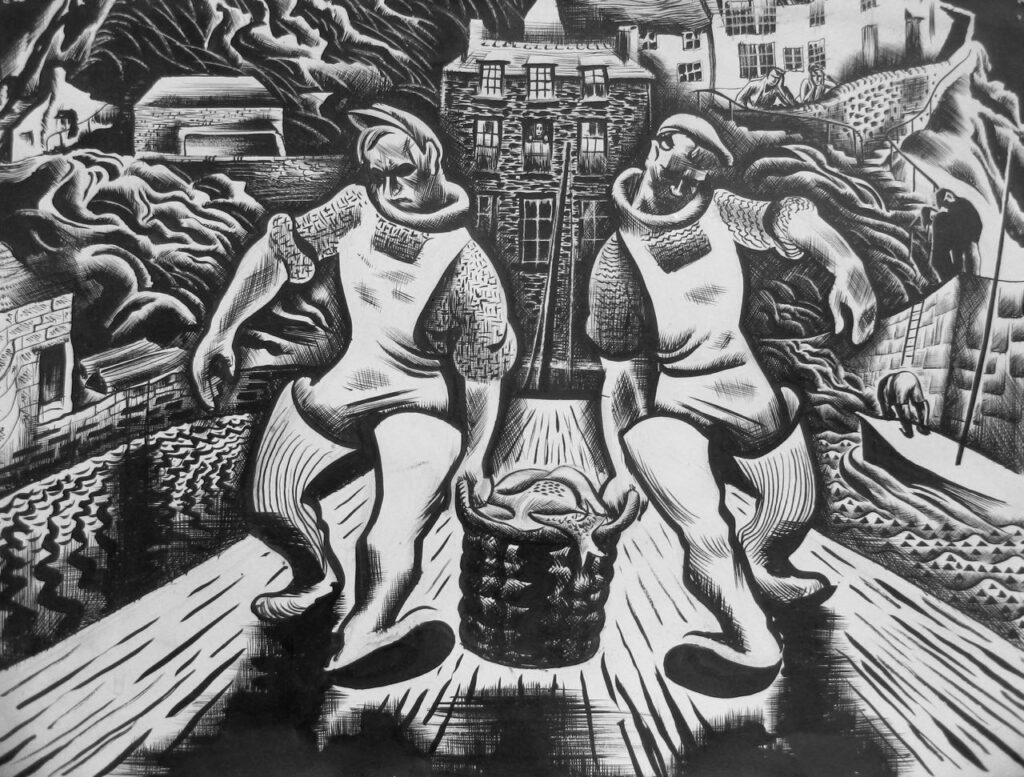
Finally, after WW2 (and with the fishing industry in Polperro being in its death throes), an art colony formed in the village. The principal figures were Jack Merriott, who was phenomenally successful as a poster artist and art teacher (known as “the Wizard of Watercolour”); Stuart Armfield, recognised as a master of painting in egg tempera, whose still life paintings were often imbued with heavy symbolism or surrealistic passages; Frederick Cook, best known for his decorative depictions in gouache of Polperro’s harbours, Anyon Cook, his wife, who was a portraitist, whose subjects included Princess Anne, aged 6, and, finally, Tom Morton, whose mental problems sadly garnered more headlines than his distinctive art.
Polperro Polemicists
During the 1930s, Polperro played host to some left wing illustrators, who railed against social injustice, fascism and warmongerers. Most prominent was Arthur Wragg, whose 1933 “epoch making book”, The Psalms for Modern Life, with its stark, black and white satirical images, caused a sensation. The editor of The Bookseller commented that, although he had spent all his life reading, publishing and writing about books, none had so amazed him heretofore. “It has shocked me into a clearer consciousness than any other single experience has ever brought me.” Wragg went on to be compared to Hogarth, Blake and Goya and was labelled a “prophet”, as so many of his dire predictions came true.
In Part 2: Polperro’s changing harbourscape, the lives of the artists and their models.