I first visited Victor Harbor in March,1997, when our children were eight and eleven and immediately fell in love with the place. It’s an old-fashioned seaside resort, close by historic whaling settlements that pre-date Adelaide. Originally called Victoria Harbour, it was mostly established in the 1860s, but one of South Australia’s earliest inns, circa 1847, is still here. There are several islands off the coast, one of which is home to the smallest species of penguin in the world, aptly named the Little Penguin, and the only one that breeds in Australia. Then there are the beaches, both calm and high surf, and miles of cliff top walks. There’s much to love.
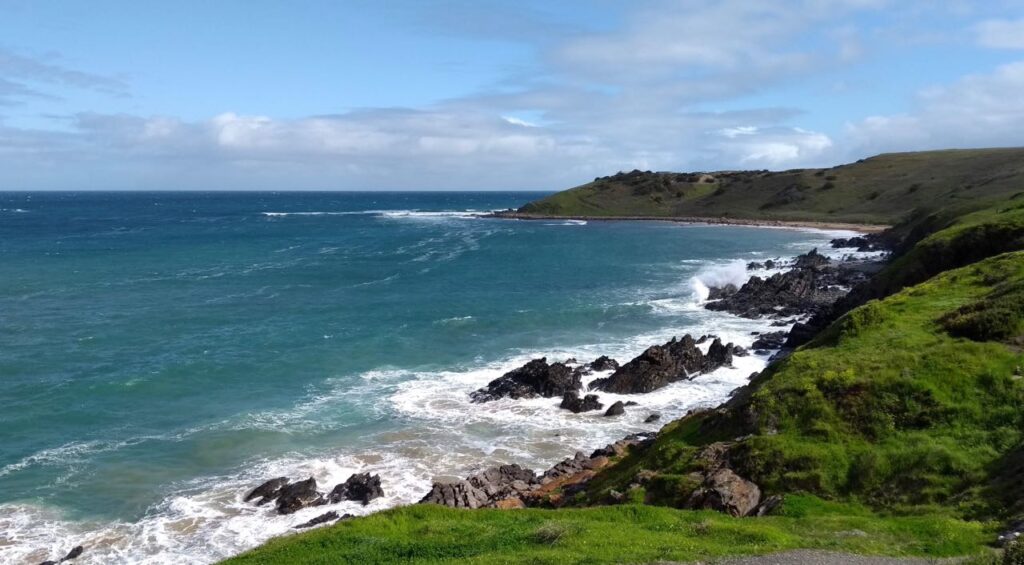
The house, on the sea front in Encounter Bay (named for the amicable encounter between the two explorers, Mathew Flinders and Nicolas Baudin), has been in Jan’s family since the 1930s. It has large rooms with large picture windows and a great number of beds. Apart from the revamping of the kitchen, it’s pretty much as it’s always been: a classic, elegant seaside house with old family crockery and cupboards full of games. Upstairs, a long narrow bedroom, known as the ‘sleep out’, is set up like a dormitory to cater for large Barker families and, invariably, this is where children, including our own, choose to sleep.
Looking back through the visitor’s books, which span almost a century, Adrian finds his first entry in 1979 when he came to South Australia from Papua New Guinea. Victor Harbor, for him, is synonymous with sunshine and pleasant heat. But in 2022, the drive down from Adelaide is rather wet. No let’s be clear: it’s tipping down. On arrival, Nigel announces that it’s the wettest drive to Victor he’s ever done in fifty years, so we’ve really scored big time. As soon as we’re in the house, he switches on the hot water and stokes up the large wood burning stove in the open-plan kitchen/sitting room, which sits at the back of the house. Of course, it’s the front rooms that have the view of the sea, but we’re all too intent on being warm to mind that fact. Besides, this room is light, airy and extremely homely and comfortable.
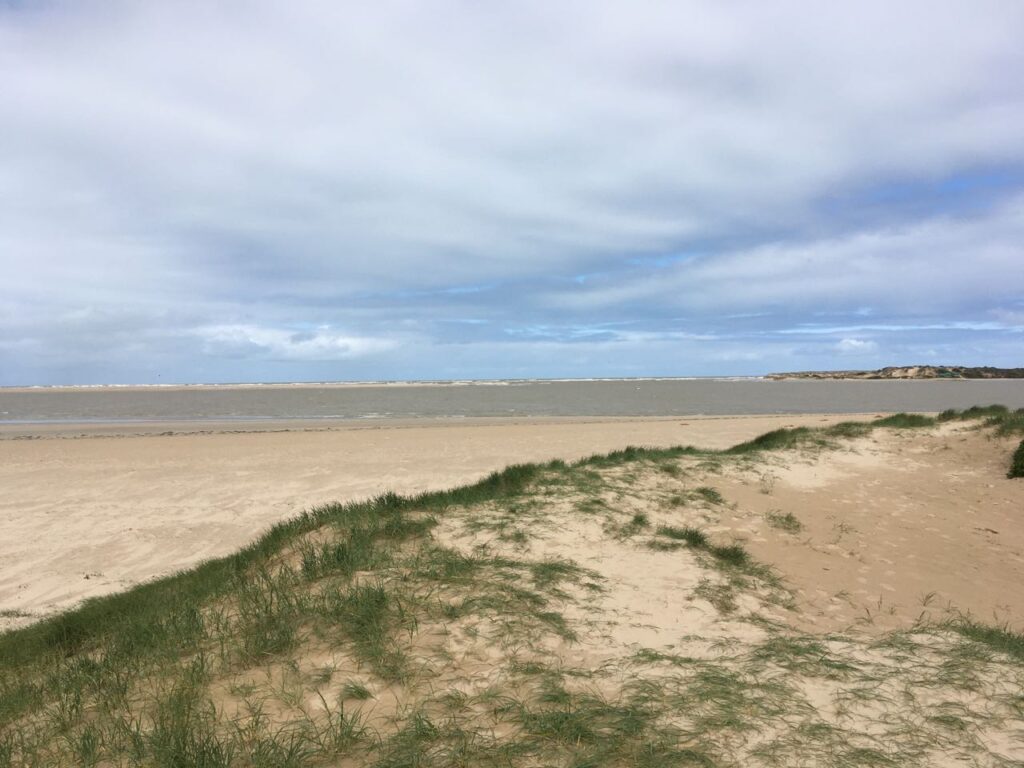
After lunch, Nigel takes us on a tour of the Bluff and the western beaches. It’s blowing a hooley, so our forays out onto the lookouts, to take in the miles of sandy beaches and pounding waves, are brief. The coastline is dramatically spectacular; today, it’s also, unsurprisingly, completely empty. Once back at the house, the sensible members of the party sit down by the fire to read the paper, while Adrian and I put on our shorts and go for a run. Pleasingly, we find we’re not the only mad runners out on the promenade and, whenever we pass each other, we salute with cheery stoicism like comrades in arms.
The following morning, we drive to the Langhorne Creek vineyards via Goolwa and the Murray Mouth. Captain Charles Sturt first came to this part of the world in 1830 and two decades later, Goolwa became Australia’s first inland port. Currently, the mouth of the Murray River is a couple of kilometres wide but this is unusual and a testament to the very wet winter that South Australia has just experienced. Generally, the mouth needs dredging to keep it open to the Southern Ocean at all: sitting between shifting sand dunes and subject to droughts and storms, it’s rather volatile and apt to change its location or silt up completely.


After a tour of the Bleesdale winery (one of the area’s oldest) and the little town of Langhorne Creek, which sits miles from anywhere in the midst of farmland and vineyards, I’m beginning to get a sense of what it must have been like for the early settlers who came here to make a life out of nothing much except land and bush. It seems astonishing to me that one of the first things these people did was grow grapes for wine. Not sheep and wheat, but wine grapes. Some distance on, at the Lake Breeze winery, we have a delicious (well priced) lunch overlooking rows of shiraz vines. It seems that the remote wine area of Langhorne Creek is a bit of a hidden gem.

On Thursday, with the wind dropped somewhat, we walk across the long bridge that connects Victor Harbor with Granite Island. Sadly, the little penguins have yet to arrive in their mating grounds and we see nothing but tourists and a few men fishing as we walk the island paths. In 1997, our children were thrilled to see the little penguins engaged in their couple dances and nesting in rocky hollows. Today, with a changing ecology – too many tourists, too many fur seals, not enough fish in the sea – the population is greatly reduced.
But our time in Victor has come to an end. We return to Adelaide for a final run up Chambers Gully and a final meal with Jan and Nigel. Chambers Gully is known for its koalas, but as I pull on my running shoes in the afternoon, Nigel says: ‘If you see a koala up there, you’re a better man than me.’ And I do! Gleefully, I walk back into the house, point at him and laugh. ‘You didn’t!’ he says. ‘I did!’ I exclaim: two round furry creatures chomping on gum leaves, very very slowly as is their style. It’s a lovely conclusion to our stay here. I think I’m just about reacclimatising to the wild Australian animals and birds that are an everyday part of life here . . . but not quite enough as yet, to dampen my excitement.

