On Friday, we find that New Zealand hasn’t quite done with us yet. By mid-morning the sky is dropping a deluge on Whangarai Bay and, within minutes, puddles are forming on the already sodden lawn. The wind gets up and hurls rain at the bach in true sub-tropical volumes and I reluctantly resign myself to a sedentary day. Adrian, sensibly, has spent the early dry hours paddling across the bay in a kayak, but I, wanting to complete some writing, have been glued to my laptop. By the afternoon, I’m regretting that choice with every twitching fibre of my body.
Then the miracle happens. Around 5pm, the rain eases and the wind loses its fury. The tide has also retreated, so the beach, sheltered from the wind, is above the water line. We reach for our jackets and squelch our way along the shell encrusted shore. It’s bliss to be out, even with those tiny sharp shells occasionally pricking my feet, and to discover that what we’ve experienced is the flicking tail of the storm that’s hit further south and moved on. The rain and wind continue to ease and, as we return, a weak sun breaks out. We’re now hopeful that we’ve seen the last of New Zealand’s storms.
Each weekend morning, our neighbour takes his boat and his friends through the headlands to catch fish. This means we’re the lucky recipients of the freshest fillets we’ve ever eaten. My father loved to fish, so as a child, I enjoyed the fish he’d just caught, but that was a long time ago and I mostly took it for granted. Not any more. It’s a happy fact of our New Zealand travels that, everywhere we go, we’re given fresh produce of one description of another. We’ve been spoiled for shop-bought food and it almost makes up for the weather!

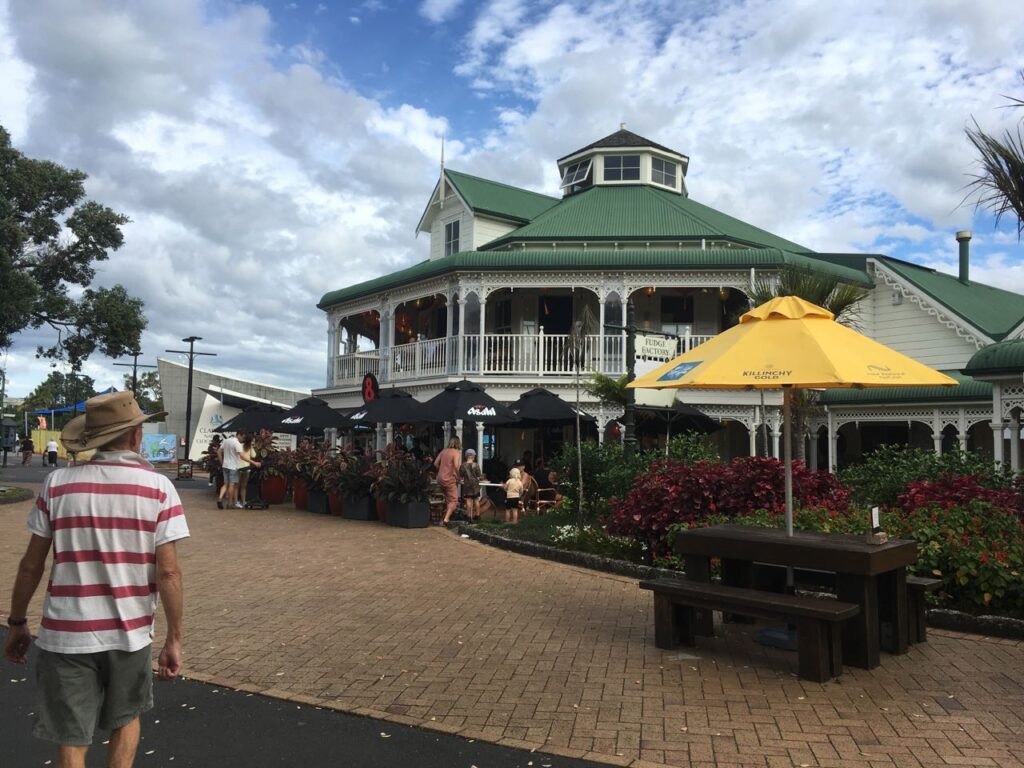
Whangarei, we discover, is celebrating Chinese New Year. It’s a charming town that sits at the head of the Bay, on the River Hatea. Its town basin is full of yachts and lined with cafes and galleries. In the park, a Chinese band is playing music that mimics birds and other wildlife, while along the shores of the river, cafes and bars in pretty colonial buildings, are quietly buzzing with people at leisure. The art gallery is quirky and made entirely of ceramics. It’s a very pleasing, sophisticated scene.
‘If this was Europe,’ remarks Adrian, ‘we’d be barely able to move for the crowds.’ But this is a rather remote part of a very underpopulated country. And still, the facilities are first class. For four months, we’ve driven freely on roads with little traffic, walked scenic paths with few (or no) people, parked where we wanted, barely witnessed a crowd and we wonder how we’ll deal with the masses in Sydney or back in the UK.
As the sun fades, we sit on the bach deck with a glass of wine and our fresh fillets of snapper. The sky works its way through every shade of red, orange and pink and the air remains warm. We feel very fortunate. But we also feel strongly that it’s time to move on. In less than a week, we’ll be flying back to Australia.

