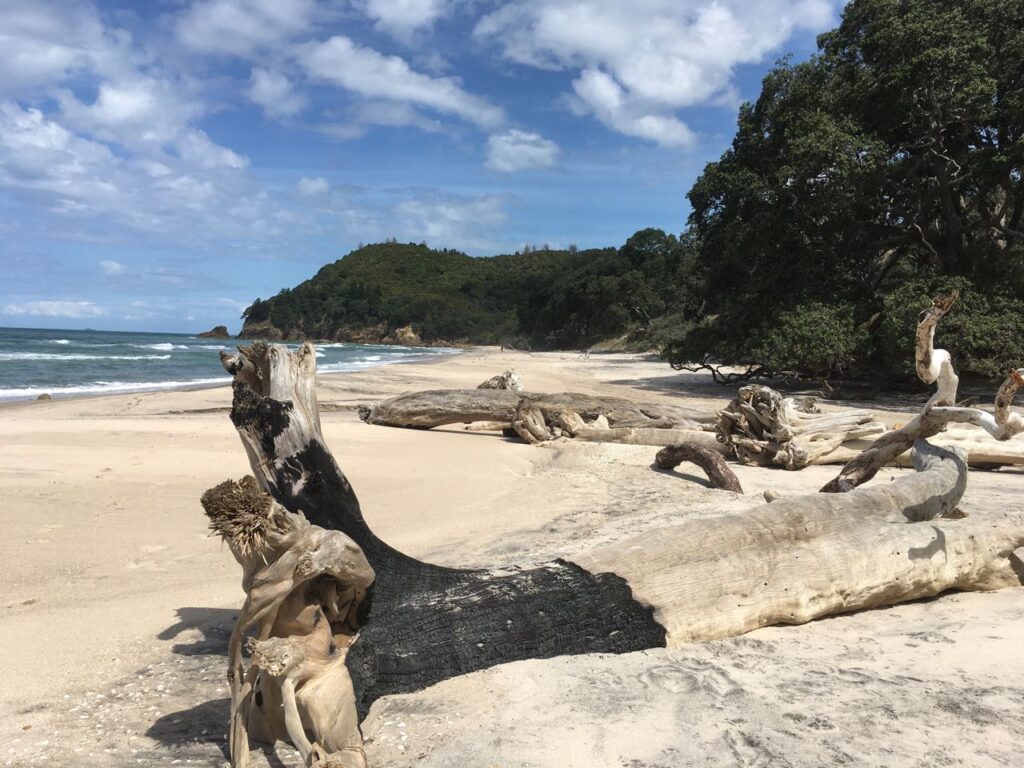
Cyclone Gabrielle is sitting out in the Choral Sea, heading in our direction, so on Friday, we take advantage of the calm before . . . well, you know the rest. We drive to Waihi Beach which is a quiet seaside resort with nine miles of white sand and some lovely cliff top walks. It also has the safest surf on the east coast, so we’re set for a perfect day. In the morning there’s a cool wind and no sun, but by the time we’ve had lunch and walked to an idyllic almost deserted beach and back again, the sun is warm and we’re ready to swim.
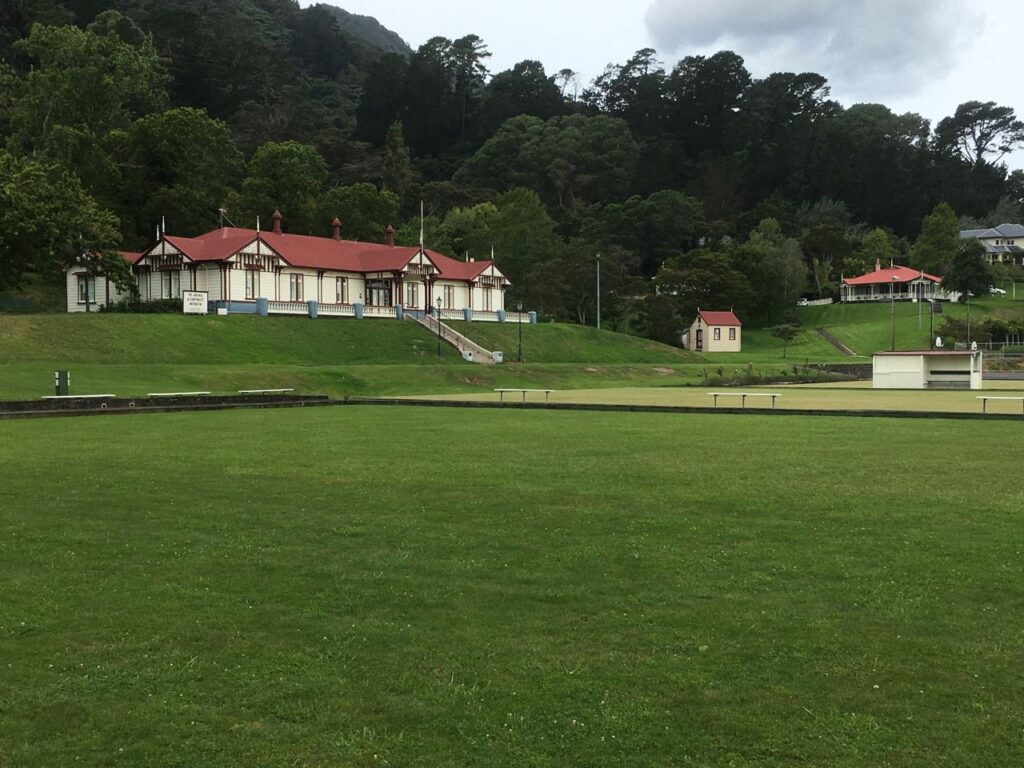
There’s been so little of this during our summer in New Zealand and we enjoy our day all the more because of that. Then, at the weekend, before the storm hits us, we explore the Domain in Te Aroha, the best preserved Edwardian spa centre in the country. It’s utterly charming with croquet lawns, warm outdoor baths, spa rooms and massage centre, cafe and art gallery. The storm will hit us in the early part of the week, so we book a spa session for Monday and escape from the howling outside world into the bliss of a hot mineral tub.
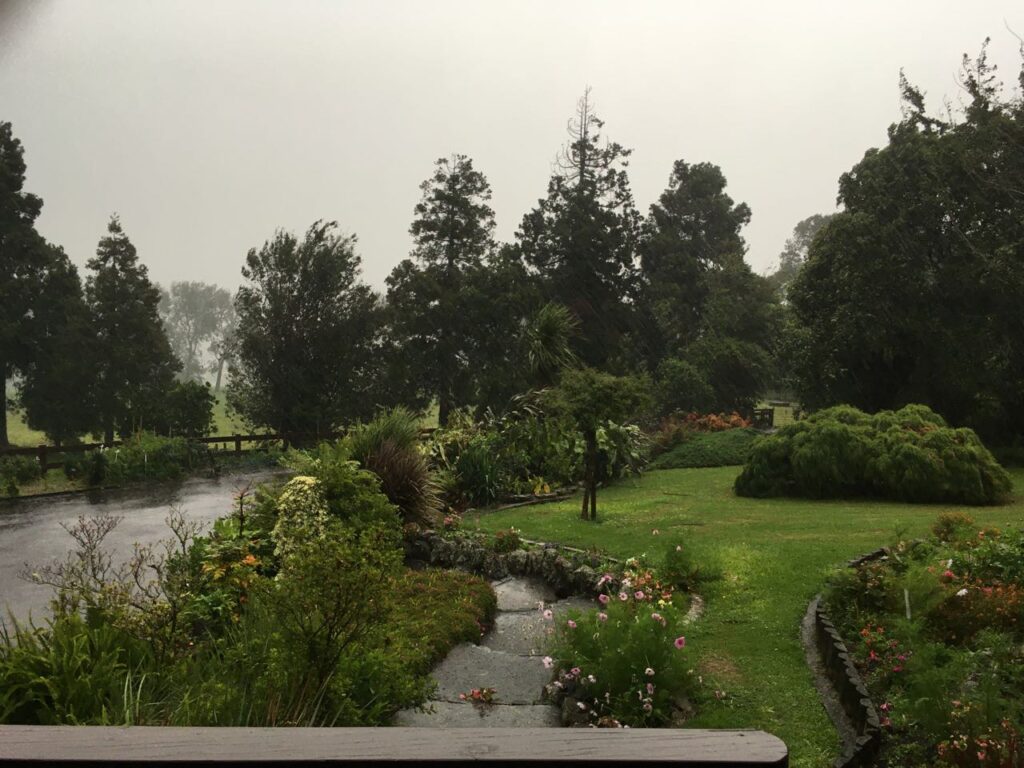
By the afternoon, the wind and rain are getting serious and the chickens are sheltering under the barn. We put them to bed early and retreat indoors to listen to the fury of the elements outside. Every so often, the chimney rattles, the lights blink off and back on and we hold our breaths.
But it isn’t until we’re reading in bed that the electricity finally gives up and we’re plunged into darkness. Well, it couldn’t happen at a more convenient time. . . . Except that Adrian can’t sleep from worrying about what steps we should be taking.
‘We can’t do anything in the middle of the night,’ I suggest, but it doesn’t work. He is restless all night, walking about the house, looking for solutions, trying to contact an overwhelmed electricity company, losing sleep. By morning, he’s been in touch with our neighbours – the only other people who live on the mountain – and they’ve logged the power outage for us. We work out our priorities and decide that number one is water.
Our water is pumped from a rainwater tank, so we’re now without that too. The outside taps are fed by the mountain stream but they’ve also stopped running. Apparently, the pipe is blocked with silt and the babbling stream is now running like a crazy river, plunging downhill, brown with mud. There’s no chance of clearing the blockage in the near future. We make a plan to head to town to buy bottled water, have some breakfast and take stock. But the first thing we encounter as we head towards the plain, is a tree across the road, our only way out.
As we assess the impossibility of moving it, a couple in a 4WD arrive and a young man with bare feet jumps out and offers to pull the tree off the road. It’s the first of many offers of help we receive that day. But neither of us has a rope. Nor do A and I have much idea of where to find one at Anna’s and Leon’s house. But the young man will wait for us to search and we drive back and embark on a hunt. Happily, Adrian locates one in a large shed and we begin the business of tying up the tree and attaching it to our rescuers’ car. In the end, the rope breaks but not before a good section of the tree top has also broken off. There’s just enough room for a small car like ours to pass and we drive on. After hot drinks and food, we fill the car with water and drive back up the hill.

Then as we approach the wreckage of the tree, we find two cars on either side of it: our only neighbours, Judy and Michael, and an unknown man who has taken it upon himself to clear more of the tree off the road. Another random bloke in a 4WD who has no particular reason to be on the mountain. We’re puzzled but very grateful. Back at the house, yet another 4WD pick up pops up to our house and two rugged men climb out. ‘Just checking if you need anything,’ one says. ‘Well, some electricity and water would be good,’ I reply, but of course there’s nothing they can do about either of those things.
It transpires that what they really want is to talk about the failures of the country and our loss of water, it seems, is as good a starting point as any. Within a minute, they’ve worked their way up to the latest in New Zealand conspiracy theories. These are perplexing and might be extremely funny if so many people didn’t take them seriously. ‘We are made of 70% water,’ one of them announces irrelevantly but with a meaningful look. ‘Makes you think, doesn’t it?’ Well, yes, but I doubt A and I are thinking the same thing as this man. (It’s actually more like 60% but it’s still irrelevant).
Then the other one draws on the Cestui Que Vie Act 1666, to suggest firstly that there’s something very suspicious about the number 1666 having 3 sixes in a row and second, that this is evidence that the government (which?) can take away one’s identity and one’s property at any time they might feel like it. He seems to think the last PM, Jacinda Ardern, introduced the act . . . And it goes on. A and I reach desperately for closing down phrases that will make them go away, but they are in full flow, talking over each other to make their ridiculous points. Finally, we escape, retreat into the house shaking our heads in bewilderment. The cyclone has been an interesting time. And we’re now much more familiar with the thinking of random blokes cruising about 4WD pick up trucks.