As we sit in KL airport waiting for our flight to Perth, I think about the lovely conversation we had over breakfast this morning. The two women, mother and daughter, had perfect English and were keen to chat to two people from out of town. It was a treat for us and confirmed, if such a thing needed confirming, that women are women everywhere; they work, raise families, get divorced, take their daughters on holiday and take care of their appearance. The daughter, still at high school, valiantly overcomes her shyness to wish us well and ask us for a selfie. We pose, make our good-byes and head for the airport. It’s a lovely note on which to leave Malaysia.

But we’re not leaving without playing tourists for a day. Melaka is billed as Malaysia’s most historical city. It’s an odd claim as, of course, every place has a history, but I suppose, being a strategic trading port, Melaka has had a bit more history than most. Originally a sultanate, the Portuguese arrived in the early sixteenth century, abolished the Sultan and promptly built a fort – A Formosa – to prevent the locals from protesting with violence about what they’d done. Then came the Dutch who adapted the fort for their own purposes, the British who blew it up to prevent the Dutch from using it, the Japanese during WW2 who used some of the Malay population to build their notorious Burma railway and, after that, well, the rest is history.
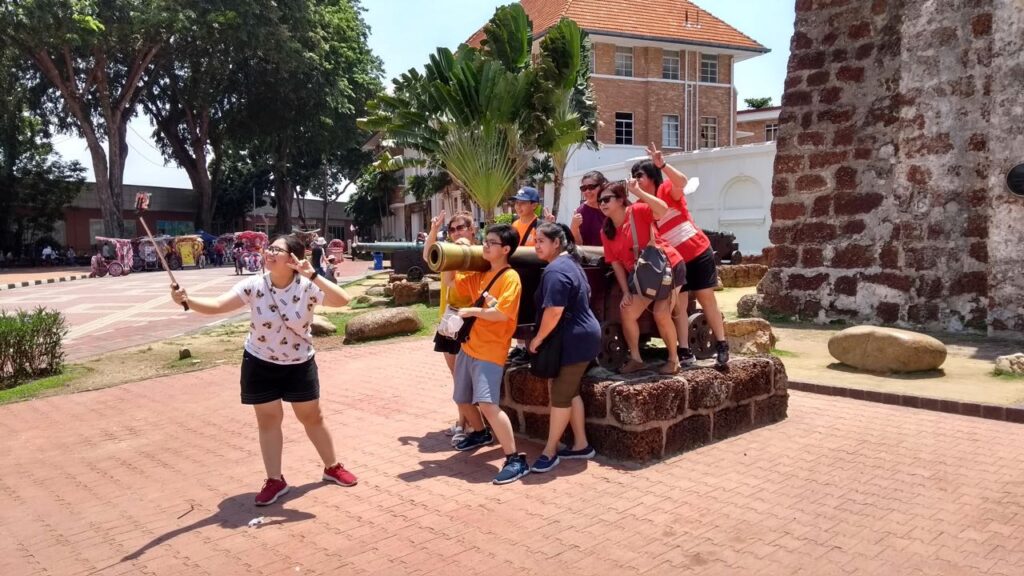
All this invading and trading inevitably resulted in a certain amount of multi-cultural mingling, creating creole children whose descendants are now recognised as distinct ethnic groups. Really? This, in an already multi-ethnic community, delightfully points up (for me at least) the pointlessness of ethnic measuring. How do you do it? And if you try to align ethnicity with religion, the picture becomes even more complicated. Yes, in general terms, the majority population is Malay and they tend to be Muslim, but you’re just as likely to find Chinese Muslims as Malay Christians or Hindus who practice Malay social customs. In fact, most of the population seem to follow a dress code. Whether on beaches or in swimming pools, I never once see a woman, in or out of the water, who isn’t covered from head to foot.
In the city of Melaka, there’s a Chinese Mosque, many ornate Buddhist temples and Christian churches, the oldest version of which – 16th century St Paul’s – sits in ruins near the site of the fort. As we climb the stairs towards it, we hear distantly but distinctly, the voice of Louis Armstrong singing (of course) ‘A Wonderful World’. Inside the ruins there’s a man with a guitar and a benign smile doing the best impersonation I’ve ever heard. As he sings the last note, a couple of out-of-Malaysians clap enthusiastically and I decide that Melaka is going to be great fun.
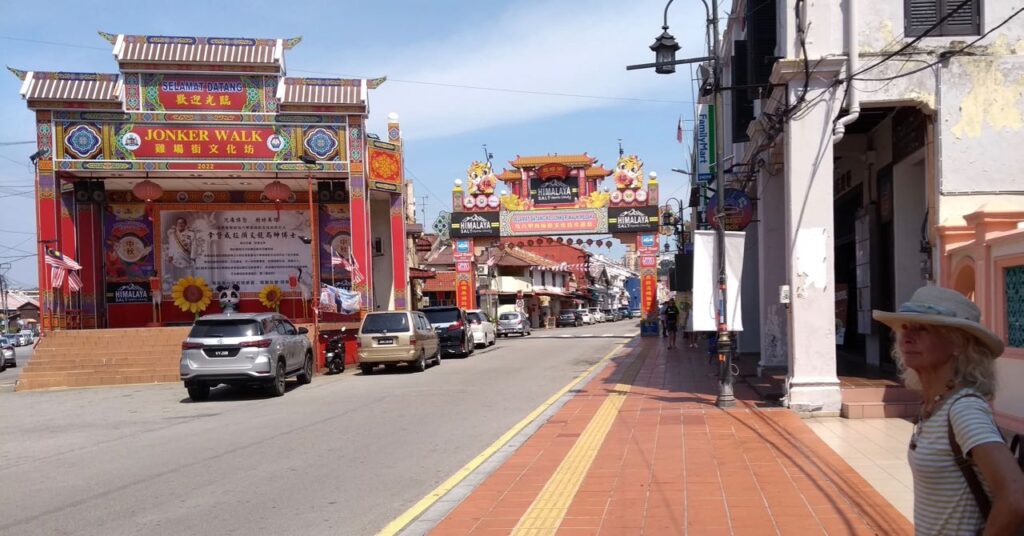
Down the other side of the hill, we make our way (with much referencing of google maps) to Jonker Street the heart of Chinatown and across the river. It’s buzzing and just a bit bonkers with tourist tat mixed with antiques and clothes shops all interspersed with the brilliant colours and gold embellishments of temple doors guarded by paintings of scarily fierce men. Later, tired and hot, we enter, gratefully, the air-conditioned shopping mall which is so long that it takes us seamlessly all the way back to our carpark.
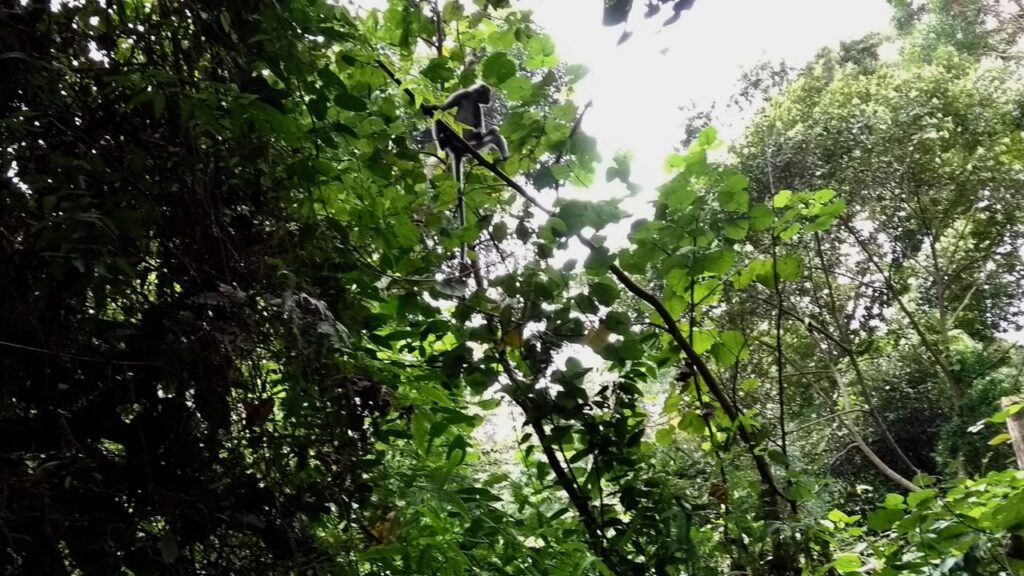
On our way back to Port Dickson, we find ourselves slowing first for cows and then, wonderfully, for monkeys all deciding that the grass, or the trees, are greener on the other side of this busy road. It’s lovely to see the monkeys; there’s been so little visible wildlife on our travels, even in the forest, and very little acknowledgement, so it seems, that there might be a brewing ecological problem. Petrol is ridiculously cheap – around £20 a tank – and cars are clearly the aspirational commodities of the day.
But perhaps Malaysia doesn’t have a problem and who are we to talk, anyway, driving around their country on the back of their cheap fuel. However, there is just a hint of concern manifested in the eco-project rainforest, through which we take a steamy climb to the Cape Richardo lighthouse. Here the ecology, complete with happily munching monkeys, is being protected. But elsewhere, development rules, land is being reclaimed, trees are being removed. Malaysia is prospering and pushing ever onwards. And who can blame them? Not me. I don’t see many Western countries doing more than playing lip service to the climate crisis and certainly very few that are setting a good example.

It’s the last morning in Malaysia and it’s going to be a long day, we’re flying to Singapore, thence to Perth arriving just before midnight. We’ve been kept up half the night by various forms of racket from other guests and now we find the breakfast room in our hotel is absolutely packed with people, there’s hardly any food and nowhere to sit. There are a couple of Muslim women wearing hijabs on a table for four and suddenly one of them gives us a beaming smile and invites us to join them. In my mind at that point I’d cursed Malaysia and everone in it to hell, which immediately goes into rapid reverse as these two lovely people (mum and daughter) chat to us and charm us. They also explain it’s still a holiday after independence day which is why it’s all so busy. Thank heavens for that one simple encounter to remind this grumpy old man that people in Malaysia are by and large actually really sweet.