While my sister, Julia, is with us in Bundeena, we talk about her husband’s illness, his decline, his death and the death of her daughter that followed so closely and cruelly after. She’s had a tragic, exhausting, debilitating couple of years. What’s more she’s the primary contact for my mother who, unhappy in her care home is constantly demanding of Julia’s time and energy. The situation is a poor one and barely sustainable. We talk. A lot. And try to at least find small solutions to some of the daily problems.
As we walk in familiar places, Julia and I also talk about our childhood and discover, as siblings often do, that we have a very different understanding of what that childhood was like. I’m eight years younger than her, so some of our memories don’t even overlap, but at times it’s as if we grew up in entirely different families. In truth, I never felt I belonged at home and left as soon as I could. In the meantime, I buried myself in school work and writing, attended my ballet classes and fantasised about being adopted. Nor have our adult lives been anything alike and this inevitably colours our views of history. So perhaps, after all, it’s unsurprising that our childhood experiences, our memories of those experiences, are rather different.

By the end of the week, Julia seems more relaxed. I’m hopeful that, if we’ve achieved nothing else, we’ve helped her to feel more supported. It’s not the answer, it’s a temporary plaster and more needs to be done. All the while, I’m acutely aware that my contribution consists of nothing beyond observations, sympathy, and the occasional holiday for my mother. It isn’t enough, but for now, it’s all I can do.
We drop Julia at Sutherland station where she takes the train back to Newcastle. I’m glad to know that she’ll be picked up by her grandchildren and taken home for lunch. In the afternoon, as A and I take a run to Maianbar and back, we look forward to an evening alone, the first in more than a month. It’s been lovely seeing family and friends, but I now need time out. I need time to let go, to think, to write. I always have done and always will. And Bundeena is the perfect place to do it.
Richard, the owner of this house, is an enthusiastic, friendly, hospitable man and he invites us on Tuesday for coffee and scones with his wife, Sandra, and a British couple, Jim and Sue. Jim’s an occupational psychologist and Sue is a psychotherapist and these two made the decision some years ago to spend the majority of their time here in Bundeena, while keeping a small pied-a-tèrre in the UK.
Apart from learning much about the practicalities of making such a move, we also hear about the varied and interesting clubs and activities that take place in this very small community. I’m delighted to hear that it’s still home to a group of artists and musicians, who regularly exhibit and stage performances. There’s a choir specialising in medieval music, a philosophy club and a poetry group . . . the list is surprisingly long and I wonder if, reminiscent of Nordic dramas, the same actors tend to pop up in different settings.
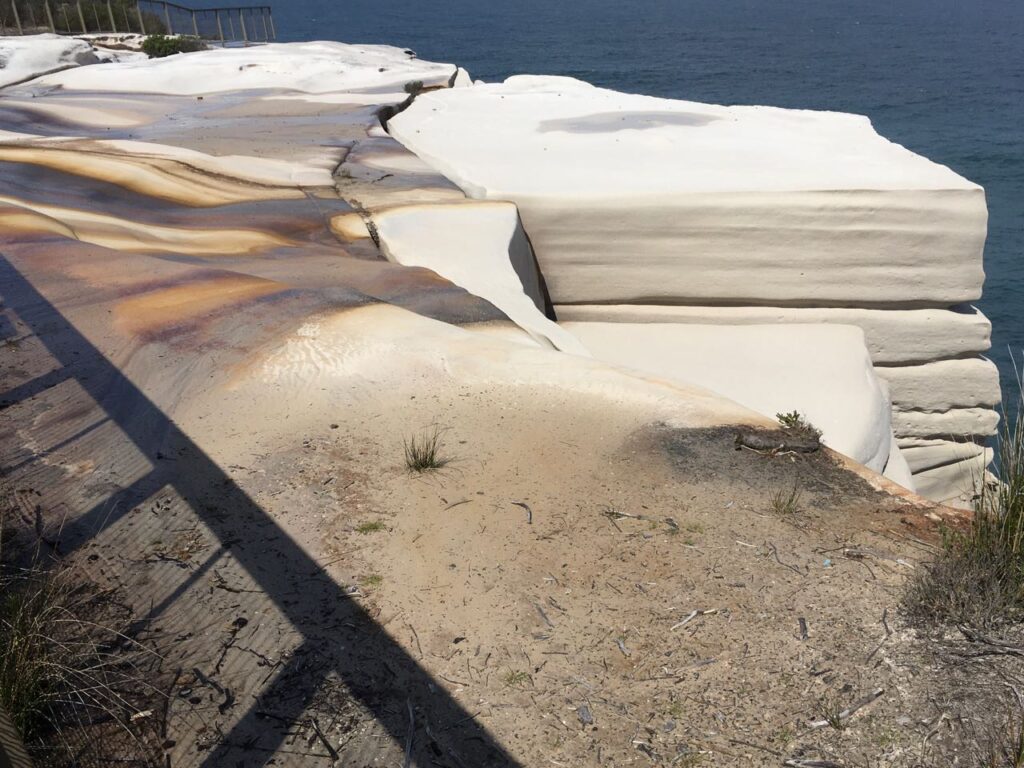
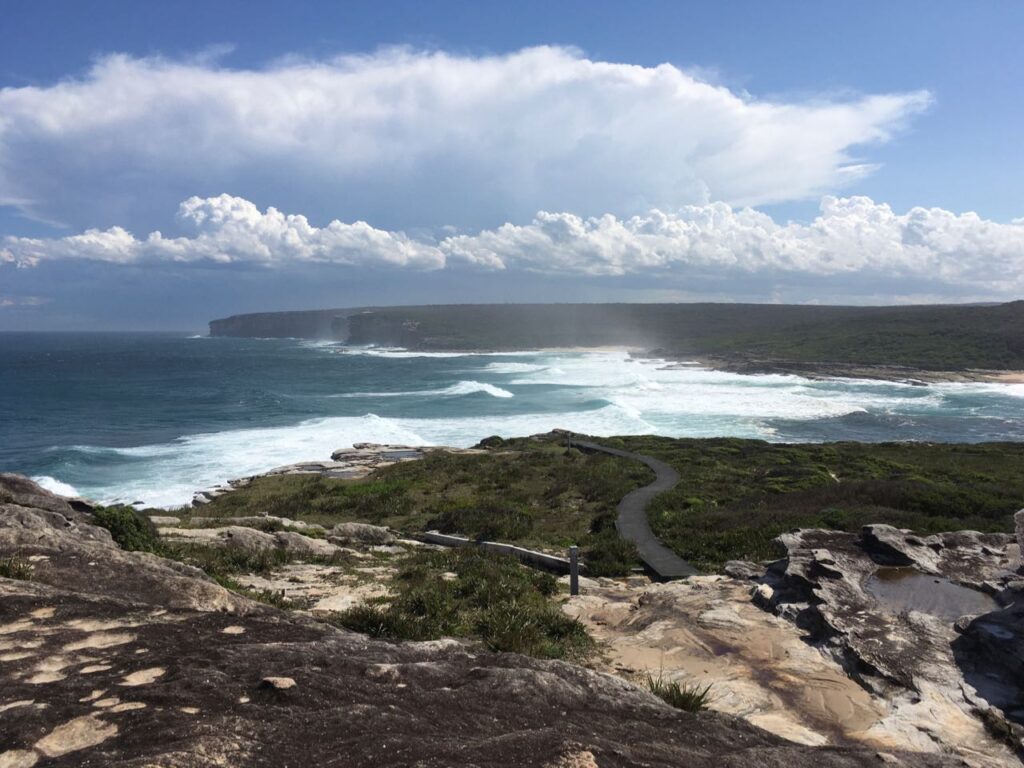
The company is very engaging, the conversation lively and it’s approaching midday before we thank them and leave. After lunch, we head out on the three and half mile coast walk to Marley beach. Rain has been forecast, but it’s sunny and hot as we tramp past the Balconies and pause at Wedding Cake Rock, so named by a tourist who, having visited from China, posted a photo of it on Tic Tok. It does indeed resemble a slice of layered cake and the name stuck. Once the news spread, Tourists turned up in their hundreds to be photographed standing on top of this lump of rock where it sits perched above the Pacific Ocean.
But the thing is, it resembles a slice of cake precisely because it’s in imminent danger of detaching itself from the rest. These cliffs are made of crumbly, porous sandstone. One can rub off the surface with a finger and the cliff edges, bashed by stormy seas, are often underpinned by no more than fresh air. Local people know this and stay back, but with gangs of young tourists forever posing on it, the national park authority took the decision to fence off the rock and keep people out. As we pass by, a young woman waves as her boyfriend photographs her sitting on the very top of the fence and we see on the other side of it right on the edge of the cliff, two women in hijabs determined to have their Wedding Cake Rock photo to post on social media.

On our return walk, we hear the distant rumble of thunder and see heavy clouds gather and darken. All at once, the sun disappears and, within a mile or so of our street, the lightening flashes in brilliant vertical lines from sky to ground. The thunder now comes in loud cracking bursts and the first random hazelnut-size drops begin to slap onto our heads and shoulders. We have maybe ten minutes.
‘Let’s run,’ I suggest and we do, increasing our speed as the wind blows up and the drops multiply. We reach the gate, sprint across the lawn and, just as the clouds release their load, we stand panting and laughing under the porch. Feeling rather smug and only slightly damp, we watch the display from inside the house. I feel as though I’ve lost ten years off my age. I also feel very very happy.
So lovely hearing your experiences in my beloved Bundeena and surrounds – you certainly have a gift with your writing Joanne❣️
It was wonderful to spend time with you, Eleanor. As you can see, your family had big impact on my childhood and it’s a delight to find the Keller house still there on Horden’s Beach, still housing Kellers! Thank you for your hospitality and walks and thanks to John for the music. xx